



OpenFlux: Censorship Workarounds Got Modular
github.com/p1neappleXpress/OpenFlux | License: GPL-3.0

A normal VPN tunnel is easy to spot once a network operator knows what to look for. Traffic has a shape, a handshake, a rhythm. OpenFlux attacks that problem from a stranger angle: hide TCP inside software people already use every day. One transport pushes packets through Yandex Docs cursor messages, another through MAX messenger’s WebRTC channel. That sounds slightly absurd, which is exactly why the repo is interesting. The point is not just evasion. The point is turning network access into an interchangeable application layer.
The Drop: When the Pipe Itself Becomes the Product
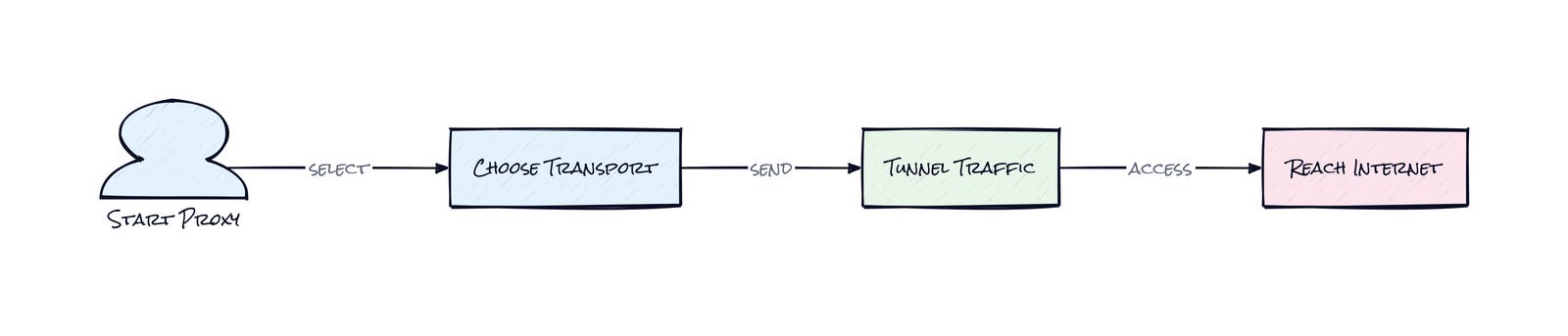
Anyone building around hostile or tightly controlled networks runs into the same wall: the transport layer gets treated like a brand. VPN, blocked. Proxy, throttled. Unknown encrypted flow, flagged. Meanwhile, ordinary consumer apps still pass because blocking them carries political, product, or support costs.
OpenFlux exists in that gap. Instead of shipping one more tunnel with a prettier UI, the project asks a more architectural question: what if the tunnel rode inside a mainstream app’s own messaging fabric? That changes the detection surface. A censor is no longer looking at “someone connected to a VPN provider,” but at activity that resembles document collaboration or a messaging session.
That frustration shows up all through the repo. There is an explicit warning about poisoned DNS on mobile. There is platform work for Android and iOS, because desktop-only tools do not matter much if the real battle is on phones. There is even careful handling on the exit node because the userspace TCP stack and the host kernel can step on each other in very annoying ways. Honestly, the pain here is not abstract privacy rhetoric. It is network plumbing shaped by adversarial conditions.
The Stack: Go, With Weird Transports Attached
Under the hood, OpenFlux is mostly Go, with a compact tunnel core, a built-in SOCKS5 proxy, and platform bridges for iOS plus companion Android work. The transport layer is the interesting dependency boundary: Yandex Docs Transport sends data through document collaboration events, while OneMe Transport uses MAX messenger’s WebRTC DataChannel. Compression, optional encryption, and a userspace TCP stack round out the setup.
The Sauce: A Tunnel Built Around Swappable Disguises
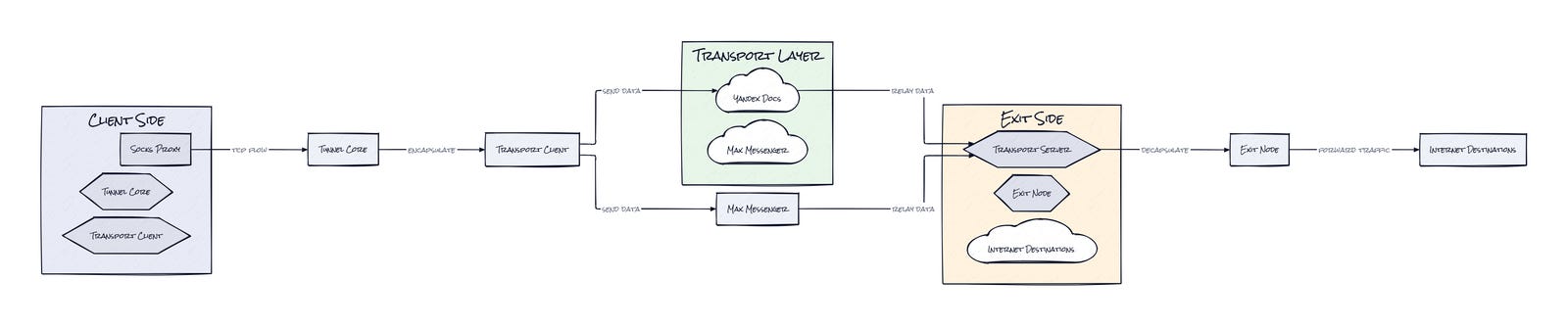
OpenFlux centers everything around a Transport interface, which is the right abstraction for this kind of project. The tunnel logic does not care whether bytes travel through document cursors, WebRTC, or some future service. That separation sounds obvious, but it is the whole trick. Many network tools hardcode the evasion method into the product. OpenFlux treats evasion as a plug-in system.
That matters because the network path is only half the problem. The repo also uses a userspace stack on the exit node, powered by gVisor, to terminate client TCP flows outside the host kernel’s normal socket model. Why bother? Because once traffic is encapsulated inside an application-level transport, a regular kernel-managed connection model becomes awkward. A userspace stack gives the project direct control over connection handling, packet forwarding, and state, while the exit node forwards requests to the actual destination on the public internet.
Mobile support makes the architecture sharper. On iOS, Packet Tunnel mode forwards raw IP packets for TCP traffic while answering DNS locally with DNS-over-TLS. That is clever because it preserves full-device routing without blowing past iOS extension memory limits. The app is not just proxying browser tabs. It is acting more like a system transport adapter.
The other nice touch is composition. CompressedTransport and encrypted wrapping can sit around any backend transport, so the repo can add stealth, efficiency, and confidentiality without rewriting the tunnel each time. That modularity is what turns OpenFlux from a one-off bypass hack into a research platform.
The Move: Use It as a Transport Testbed
Plenty of people will look at OpenFlux and see a consumer circumvention tool. That undersells it. The better use case is as a strategic testbed for anyone studying how application-layer channels can carry resilient connectivity, especially on mobile.
Researchers can compare which mainstream services produce the best blend of throughput, survivability, and operational risk. Security teams can model what benign-looking collaboration traffic means when it doubles as a tunnel. Founders building privacy, enterprise networking, or edge access products can use OpenFlux to pressure-test a bigger idea: transport should be a policy choice, not a monolith.
Practically, that means spinning up an exit node on a VPS, choosing a transport backend, and routing selected traffic through the local SOCKS5 proxy or mobile VPN client. Then the useful part begins, measuring failure modes. Which services rate-limit weird behavior? Which channels survive captive portals or DNS poisoning? Which mobile environments kill background sessions fastest? That is the compounding advantage. OpenFlux helps teams learn where the real bottlenecks are before turning a networking thesis into a product roadmap.
The Aura: Software Starts Hiding in Plain Sight
People change behavior fast when access becomes uncertain. They stop assuming the internet is a neutral pipe and start treating connectivity as something negotiated, brittle, and political. OpenFlux leans into that reality. The repo suggests a future where ordinary apps double as infrastructure, whether their operators intended that or not.
That is the bigger psychological shift. A document editor stops being just a document editor. A messenger stops being just a messenger. Products become carriers for adjacent capabilities, and users start expecting optionality beneath the surface. Quietly, the interface layer becomes a trust layer.
The Play: Better Mousetrap, Huge Optionality
This is not a clean 0-to-1 category creation. Circumvention, secure tunneling, and transport obfuscation already exist. But OpenFlux points at a broader TAM than “VPN users,” because the same architecture could matter for enterprise remote access, mobile reliability tooling, censorship-resilient communications, and protocol research. The early signal is not raw star count alone, though 1,348 stars for a niche network repo is respectable. The signal is that the project already has mobile clients, multiple transports, and a community willing to extend the backend model. The moat is probably not data or network effects. It is execution speed around new transports and the operational knowledge of which mainstream services can carry traffic without collapsing usability.
Winners:
Tailscale: Distribution expands because modular transports could eventually make private networking more resilient in restrictive environments, raising LTV in edge cases competitors ignore.
WireGuard, Inc.: Demand for lightweight secure tunneling compounds if customers start expecting transport flexibility on top of familiar VPN primitives.
Akamai: Enterprise security spend benefits if application-aware traffic analysis becomes more valuable when ordinary collaboration flows can mask tunnel behavior.
Losers:
Nym: Positioning erodes because bespoke privacy routing looks less differentiated when practical app-layer transports can offer “good enough” evasive connectivity with less user friction.
ExpressVPN: CAC pressure rises if users increasingly view branded VPN endpoints as the easiest thing for networks to fingerprint and suppress.
Zscaler: Inspection confidence weakens when sanctioned-looking SaaS traffic may also function as a covert transport, making policy enforcement messier and more expensive.
tl;dr
OpenFlux turns mainstream apps into pluggable network transports for TCP tunneling, with mobile support and a surprisingly clean architecture. The smart part is the transport abstraction plus userspace packet handling, which makes new disguises easy to add. Worth a look for networking researchers, security teams, and founders thinking beyond traditional VPN products.
Stars: 1,348 | Language: Go
