



Financial Services: Wall Street Gets a Plugin Layer
github.com/anthropics/financial-services | License: Apache-2.0

A banker updating comps, an equity analyst revising a note after earnings, a fund admin tracing a broken ledger line, these are not glamorous software problems. They are messy workflow problems with expensive humans sitting in the loop. That is why this repo stands out. Financial Services is not selling a chatbot fantasy. It packages repeatable finance work into deployable agents and skills, then lets firms run the same logic either inside Claude’s UI or behind their own systems. Honestly, that distribution choice matters more than the finance branding.
The Drop: Finance Workflows Hate Generic AI
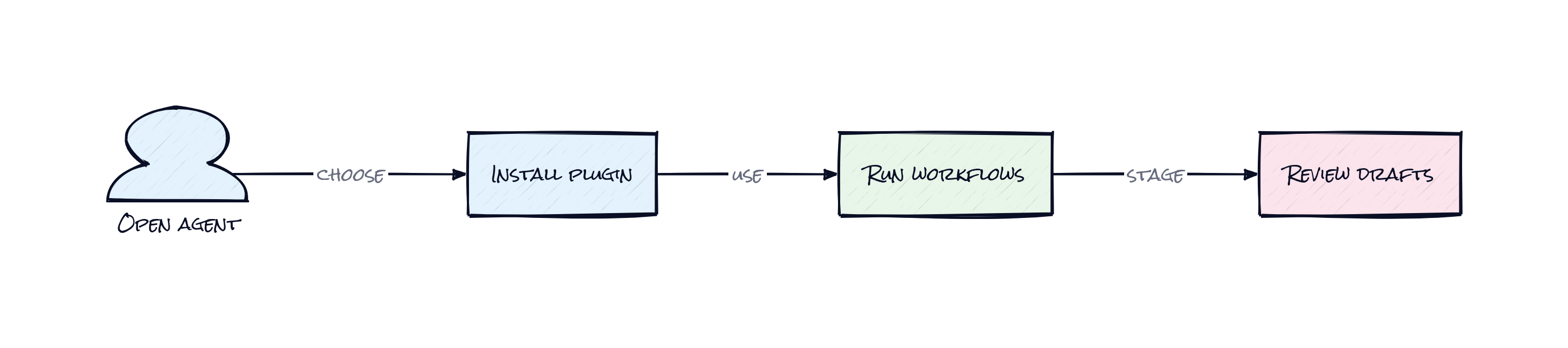
Banks and asset managers already have access to smart models. The pain is everything around them. A generic assistant can summarize a filing, sure, but finance teams do not get paid for summaries. They get paid for producing work product that follows house style, pulls from approved data sources, survives compliance review, and lands in Excel, PowerPoint, or internal systems without turning into a trust exercise.
Pitch Agent, Market Researcher, and GL Reconciler exist because these jobs are really bundles of small, fussy steps. Pull the right data. Apply the right method. Format the output correctly. Route anything risky to a human. Miss one step and the whole thing becomes unusable. That is the hidden frustration here. AI in finance usually breaks not on intelligence, but on workflow integrity.
Another issue, less obvious but more important, is deployment politics. Some teams want a polished plugin inside Claude Cowork. Others need headless automation inside their own orchestration stack, with tighter controls and auditability. Rebuilding the same workflow twice is the kind of operational nonsense enterprises somehow tolerate. Financial Services is reacting to that exact gap: one authored workflow, two delivery surfaces, same behavior. That is the practical unlock.
The Stack: Python Meets Markdown Ops
Under the hood, Financial Services is mostly Python plus a surprisingly file-centric packaging model. The system combines Claude plugins, Managed Agents, markdown-defined skills, JSON and YAML configuration, and MCP connectors to external finance data providers like PitchBook, FactSet, Moody’s, and LSEG. Minimal build machinery, lots of structured prompts and wrappers.
The Sauce: One Source, Two Runtime Surfaces
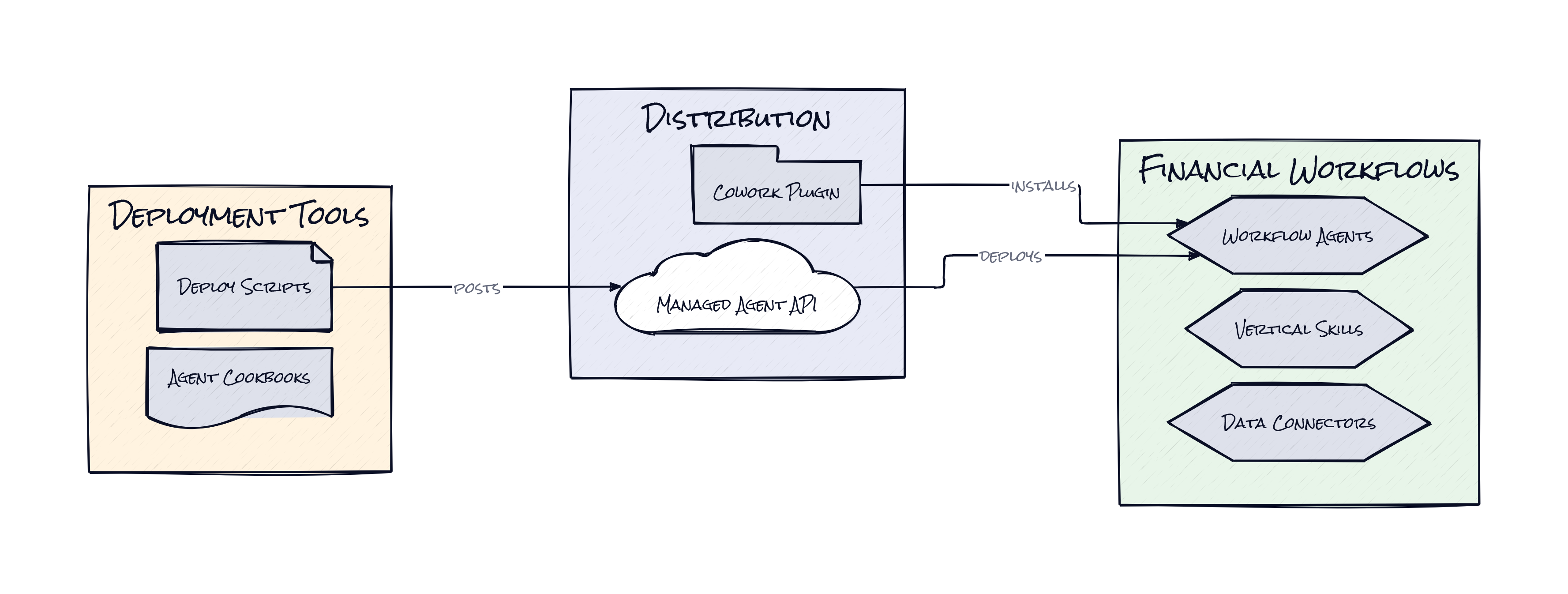
Plenty of AI repos bundle prompts and connectors. The interesting part here is the dual-surface architecture. Each workflow is authored once, then exposed in two modes: as a Cowork plugin for interactive use, and as a Managed Agent cookbook for API deployment. Same system prompt, same domain skills, same underlying logic. Different runtime context.
That sounds simple, but it solves a nasty enterprise problem. Usually, the interactive version of an AI workflow becomes a demo, while the API version becomes a separate product with diverging behavior. Financial Services keeps those from drifting apart by treating the workflow definition as the product, not the UI wrapper. The plugin is one shell. The managed agent is another shell. The core asset is the reusable package of skills, commands, connectors, and orchestration hints.
The second smart choice is how specialization is layered. Vertical bundles like investment banking or equity research define reusable methods, while named agents package the exact subset needed for an end-to-end job. In practice, that means a firm can install broad capability, e.g. comps, DCF, deck checks, or adopt a tightly scoped operator like a meeting prep flow. This feels a bit like Notion templates crossed with enterprise APIs, except the unit of reuse is operational judgment.
Even the leaf-worker subagents matter. Rather than asking one giant prompt to do everything, Financial Services breaks work into role-shaped workers, e.g. transcript reader, model updater, note writer. That improves control, reviewability, and handoffs, which is exactly where regulated industries get nervous.
The Move: Use It Like an Operating System Add-On
Adopting Financial Services as a strategy is less about replacing analysts and more about standardizing how draft work gets produced. A boutique bank could deploy Meeting Prep Agent and Pitch Agent to compress turnaround on client coverage while keeping final review with associates and VPs. A PE fund could wire Valuation Reviewer into quarterly reporting so package intake, template runs, and staging happen in a consistent sequence. A finance ops team could use Month-End Closer or Statement Auditor to shrink the boring but high-risk parts of close.
Firms with lighter technical resources can start in the plugin model, where the value is fast distribution and fewer integration headaches. Teams with stronger platform muscle should use the managed agent path and connect the workflows to internal approvals, identity rules, and document stores. That is where the repo turns from demo to advantage.
The strategic edge is not just speed. It is policy-compliant repeatability. Once a workflow is encoded with approved connectors, review steps, and output conventions, every new analyst effectively starts with the same institutional memory. Execution quality becomes less dependent on who happened to be online at midnight.
The Aura: Institutional Memory Becomes Portable
Junior finance work has always been shaped by hidden playbooks, the unofficial checklist in someone’s head, the formatting instinct learned after three brutal markups. Financial Services makes that tacit knowledge portable. A workflow can be inspected, packaged, reused, and governed instead of living as office folklore.
That changes expectations. Teams start asking not whether AI can answer a question, but whether a process can be made reviewable end to end. Subtle difference, big consequence. The human role shifts upward, from manually assembling first drafts to judging exceptions, context, and risk. In finance, that is probably the only AI story with durable credibility.
The Play: Vertical AI With Distribution Built In
From a VC lens, this looks less like a pure 0-to-1 category creation and more like a sharp wedge into a very large existing TAM: financial workflow software, research tooling, compliance operations, and office productivity inside highly paid knowledge work. The PMF signal is not just 10,788 stars, it is that the repo packages concrete jobs people already pay real budgets for, and it arrives with partner connectors plus dual deployment paths. Moat is not raw model access. Moat comes from workflow depth, embedded approvals, and switching costs once firms encode house process into these agents.
Winners:
Rillet: Faster month-end and reconciliation expectations make AI-native accounting systems more valuable because automation compounds when the ledger is already structured for machine review.
Ramp: Higher demand for finance workflow automation strengthens its move upmarket, where spend controls, close workflows, and AI-assisted ops can increase LTV without brutal CAC expansion.
BlackRock: Better internal research and reporting throughput boosts operating leverage because large asset managers can spread workflow standardization across huge analyst and operations teams.
Losers:
Arc: More capable finance-specific AI workflows erode the value of generic talent marketplaces for analyst grunt work, and adaptation is hard when buyers want governed software, not flexible labor.
Carta: Agentized valuation review and fund admin pressure parts of the back-office stack where workflow speed matters, but product sprawl makes focused AI retrofits slower.
Donnelley Financial Solutions: Drafting, reconciliation, and reporting automation chip away at services-heavy revenue tied to repetitive financial document production, where incumbents carry process baggage and slower iteration cycles.
tl;dr
Financial Services turns finance workflows into reusable Claude plugins and managed agents, with the same logic deployable in a UI or through APIs. The clever bit is the one-source, two-surface architecture plus reusable vertical skills. Worth a look for banks, funds, finance ops teams, and anyone tracking vertical AI with real enterprise shape.
Stars: 10,788 | Language: Python
