



Qbittorrent: Piracy’s Best Product Team
github.com/qbittorrent/qBittorrent | License: Other

Streaming won, sure. Yet the minute a file is rare, region-locked, absurdly large, or one takedown away from disappearing, centralized platforms start looking fragile. That is where qBittorrent keeps feeling stubbornly relevant. Not because torrents are trendy again, but because the internet still needs distribution systems that do not depend on a single company staying generous. qBittorrent’s appeal is almost boring in the best way: download files fast, stay out of the way, expose enough control for power users, and never treat the user like an upsell funnel.
The Drop: The Internet Still Has a Distribution Problem
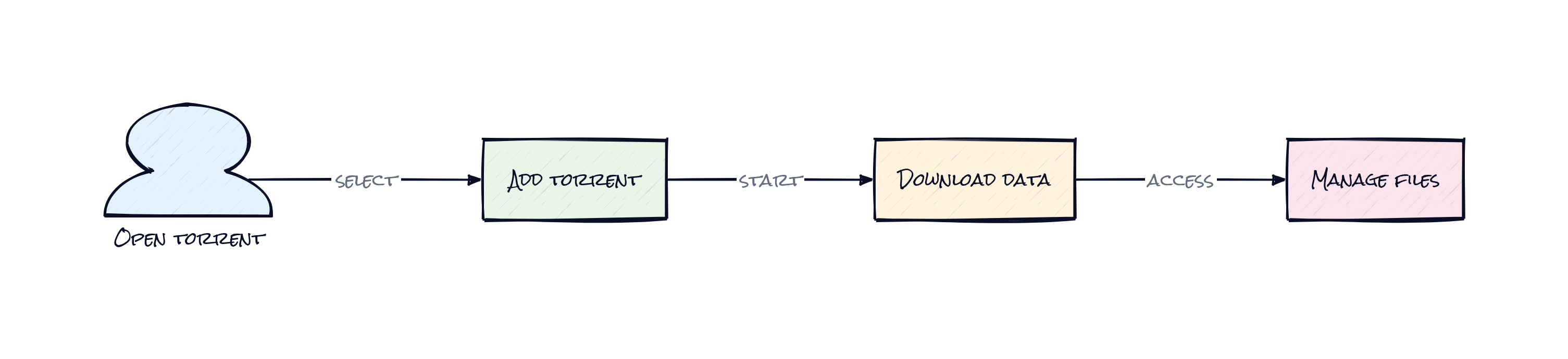
Spotify, Netflix, and Google Drive trained people to expect instant access, but that expectation breaks the second a platform decides a file is too expensive, too niche, or too legally annoying to host. BitTorrent solved that gap years ago, and the frustrating part is how many clients wrapped that useful protocol in junk: ads, spyware accusations, dark-pattern installs, or interfaces that felt frozen in 2009.
qBittorrent exists because the protocol was never really the problem. The product layer was. People needed a client that felt trustworthy, worked cross-platform, handled magnet links and trackers cleanly, and did not bury basic controls under clutter. That matters more than it sounds. In peer-to-peer systems, confidence is infrastructure. If users do not trust the client, the whole network effect gets weaker.
What makes qBittorrent endure is that it treats torrenting like serious software instead of a sketchy side quest. Honestly, that alone made a category.
The Stack: Qt on Top, Libtorrent Underneath
Under the hood, qBittorrent is mostly C++ with Qt handling the desktop interface, cross-platform behavior, and the broader application framework. The networking and torrent session logic ride on libtorrent, which is basically the battle-tested engine for peer discovery, piece exchange, trackers, and swarm management.
That split is clean: Qt runs the product experience, libtorrent runs the protocol-heavy machinery.
The Sauce: A Consumer App Wrapped Around Serious Network Plumbing
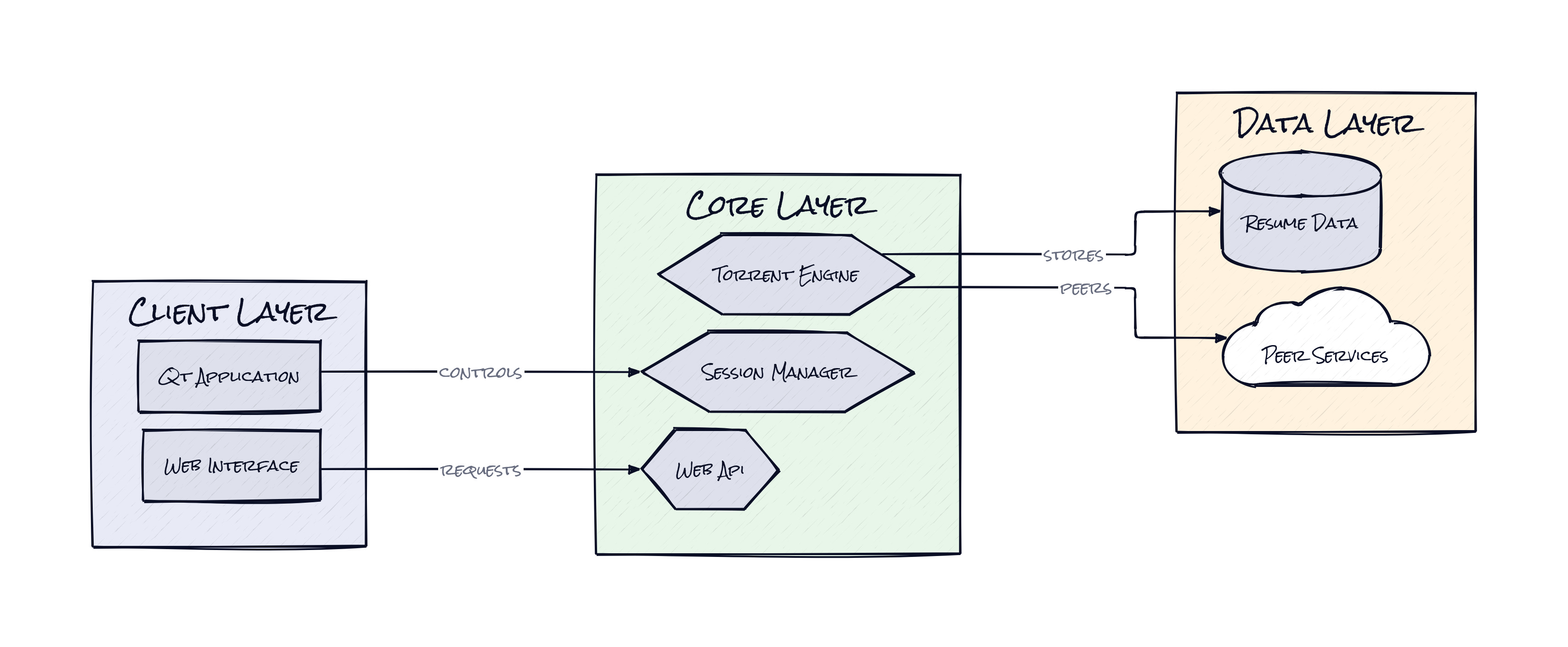
What stands out is the architectural separation between Session, the long-running coordination layer for the torrent engine, and the user-facing controls exposed through both a desktop GUI and a Web UI. That sounds straightforward, but it is the reason qBittorrent punches above its weight.
The app is not just a pretty shell around downloads. qBittorrent treats torrenting as a stateful system that needs durable preferences, peer visibility, bandwidth scheduling, category management, queueing, filtering, and remote control without turning into enterprise sludge. The session layer keeps track of swarm state, disk constraints, trackers, metadata, and network conditions, while the interface layer translates that into something a human can actually steer. That division is smart because BitTorrent is noisy by nature. Peers appear and vanish, trackers fail, metadata arrives late, disk space changes, priorities shift. A clean coordination layer prevents the product from feeling chaotic.
The other quietly strong decision is supporting both local and remote administration. qBittorrent is a desktop app, but it also behaves like a lightweight control plane through its web interface and API surface. That makes it useful beyond the laptop. Run it on a home server, a NAS, or a low-power box, then manage jobs from anywhere. In product terms, this is why qBittorrent stayed sticky while other clients felt disposable. It is not just a downloader. It is a dependable endpoint for decentralized file logistics.
The Move: Turn a Downloader Into Personal Infrastructure
Plenty of people use qBittorrent as a one-off utility, grab a file, close the app, forget about it. That misses the strategic upside. The better move is to treat qBittorrent like an always-on distribution node for anything that benefits from large-file transfer, redundancy, or asynchronous delivery.
A small media team can use qBittorrent to move giant archives without paying recurring cloud egress on every handoff. A research group can distribute datasets that would punish a central server during traffic spikes. A collector can keep hard-to-find public domain media, Linux ISOs, or niche archives seeded long enough that the material does not vanish. Pair the web interface with a home server or NAS and qBittorrent becomes quietly powerful, the kind of tool that keeps working while subscription software keeps invoicing.
There is also a privacy and resilience angle here. Centralized hosting creates a single choke point for policy, pricing, and outages. qBittorrent gives users an alternate rail. Not glamorous, but very real.
The Aura: Ownership Starts to Feel Normal Again
Convenience changed expectations, but dependence changed behavior even more. People got used to asking permission from platforms for access to files they technically never possessed. qBittorrent nudges that mindset back toward custody, persistence, and direct exchange.
That feels bigger than torrenting. A tool like this reinforces the idea that the internet can still be participatory infrastructure, not just rented shelves inside five companies’ clouds. Control becomes a default setting again, not a premium feature. For users, that changes the emotional contract with software. Access stops feeling temporary. Storage stops feeling abstract. Distribution stops feeling like something only platforms are allowed to do.
The Play: Decentralization as a Durable Utility
From a VC lens, qBittorrent is not a 0-to-1 startup wedge today, it is proof that the market for resilient file distribution never disappeared. The TAM is broader than piracy discourse suggests: home servers, media ops, research data transfer, open datasets, edge distribution, and prosumer infrastructure. PMF signals are obvious, 36,000-plus stars, years of community maintenance, and enduring mindshare in a category where trust compounds into retention.
The moat is not proprietary data. It is execution, reliability, and behavior-level switching costs. Once a user wires qBittorrent into a NAS, automation stack, or remote workflow, churn drops because the habit is infrastructure-shaped, not app-shaped.
Winners:
Siyuan: Stronger self-hosted habits make adjacent personal data tools more attractive, and that compounds as users normalize running serious software on their own machines.
Plex: More dependable peer-to-peer acquisition and home server workflows increase the value of organizing and streaming personal libraries at scale.
Synology: Higher comfort with always-on home infrastructure drives more demand for NAS hardware that can quietly become the control center for storage and transfers.
Losers:
Transfer.zip: Free peer-to-peer file transfer products lose novelty when users adopt heavier-duty tools with persistence, scheduling, and remote administration.
Dropbox: Marginal large-file transfer use cases become harder to monetize when power users can bypass cloud egress and centralized storage for many workflows.
Box: Enterprise file distribution looks less defensible at the edges when teams get comfortable with lower-cost, user-controlled transfer rails for bulky assets.
tl;dr
Qbittorrent turns BitTorrent into dependable, polished software instead of a sketchy utility. The interesting part is the architecture, a stable libtorrent core wrapped in desktop and remote control layers that make decentralized transfer actually usable. Worth a look for anyone building home server setups, moving big files, or betting on user-owned infrastructure.
Stars: 36,973 | Language: C++
