

The Push: June 6th, 2026
AI that remembers, researches the last month, and keeps your context from leaking between projects

Personal AI Infrastructure: Your Life Gets a Control Plane
github.com/danielmiessler/Personal_AI_Infrastructure | License: MIT

An AI chat window feels smart right until it forgets last week’s decision, loses the thread on a long project, and treats your priorities like disposable context. That gap gets expensive fast. Not in API spend, in attention. Personal AI Infrastructure goes after that exact failure mode by treating AI less like a helpful tab and more like a persistent system around your goals, memory, and operating habits. The ambition is borderline audacious, but honestly, that is what makes this repo worth paying attention to.
The Drop: When Chat Memory Stops Being Cute

ChatGPT, Claude, and every other assistant keep selling the same dream: one interface for everything. Then real life shows up. Research lives in one thread, planning in another, notes in five places, and the assistant has no durable sense of what actually matters across health, work, relationships, or long-running projects. You end up re-briefing a machine that was supposed to save time.
Personal AI Infrastructure starts from that annoyance and pushes it further. The repo argues that the missing layer is not another better prompt, not another model switcher, and not another automation toy. The missing layer is a personal system that stores identity, goals, memory, workflows, and evaluation in one place. That is why the project calls itself a Life Operating System, not just an agent toolkit.
Plenty of AI products offer convenience. Very few offer continuity. That distinction matters because continuity is where compounding happens. Without it, every session resets your momentum. With it, the assistant can stop acting like an intern on day one and start acting like software that actually knows the shape of your life.
The Stack: Text Files Over Fancy Databases
Under the hood, Personal AI Infrastructure is mostly TypeScript running on Bun, with a surprisingly broad pack system layered on top for skills, workflows, agents, and integrations. The architecture leans hard on Markdown and plain text storage, plus shell-level tools and lightweight extensions, instead of building around a traditional database-heavy retrieval stack.
The Sauce: The Filesystem Becomes the Intelligence Layer
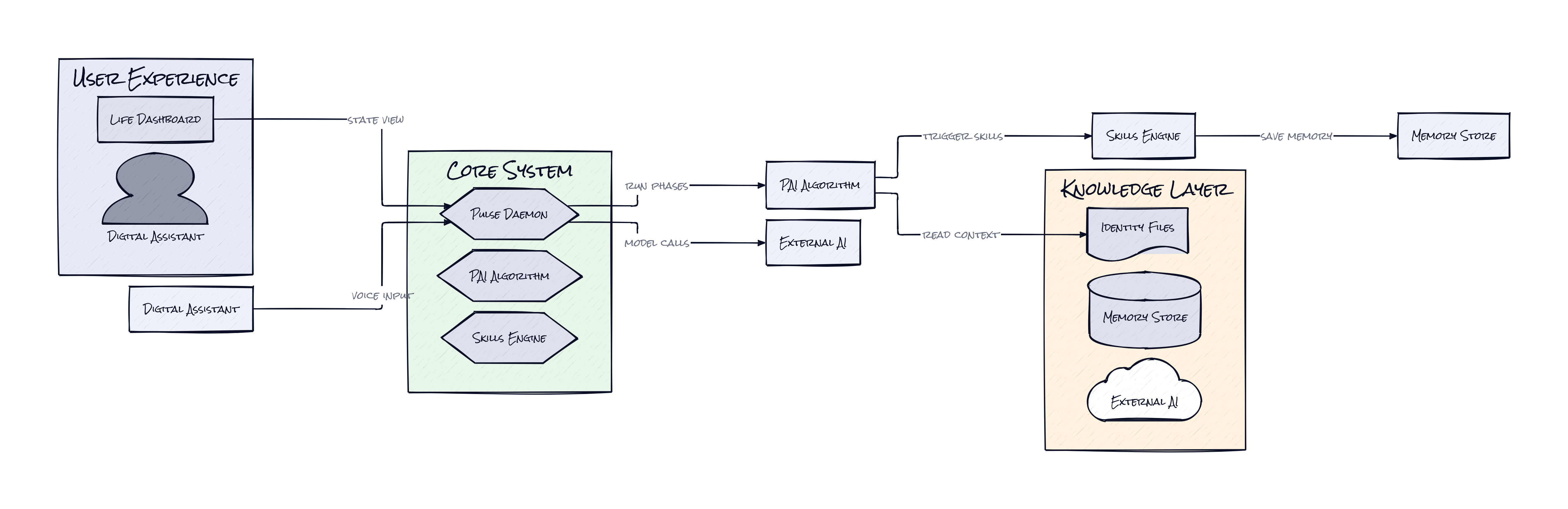
Buried inside the repo’s philosophy is the design choice that makes the whole thing interesting: filesystem as context. Instead of centering the system on embeddings, vector databases, and retrieval pipelines, Personal AI Infrastructure stores memory, identity, goals, and workflows as readable text with cross-links, then treats search and structure as the retrieval layer. That sounds almost contrarian in 2026, which is exactly why it stands out.
The project builds several named layers on top of that choice. Pulse is the always-on dashboard and daemon that tracks state and surfaces what matters. DA is the persistent digital assistant identity, the persona and interface layer you actually interact with. ISA, short for Ideal State Artifact, is the planning primitive that defines what “done” looks like for a task, then breaks that into checkable criteria. Finally, The Algorithm routes work from current state to ideal state through a structured loop, with evaluation and self-improvement built in.
That stack is clever because each layer solves a different failure mode. Pulse handles visibility. DA handles continuity of interaction. ISA handles ambiguity. The Algorithm handles execution discipline. Together, they create something closer to a personal operating model than a chatbot wrapper.
The repo’s rejection of classic RAG is the bold bet. Search over rich text is simpler, more inspectable, and often more faithful than embedding-heavy setups that quietly drop nuance. For a personal system, that tradeoff seems unusually sane.
The Move: Turn Personal Context Into Strategic Surface Area
Founders, operators, researchers, and students could use Personal AI Infrastructure as a private command center for ongoing work that keeps sprawling across tabs and tools. Feed it meeting notes, planning docs, decision logs, reading highlights, and project goals. Then let the system organize not just information, but direction. The payoff is not novelty, it is consistency over time.
Teams could also adapt the same pattern internally. A product lead might define an ISA for a launch, store the criteria, attach research and customer context, and keep Pulse tracking what changed. A founder could maintain one assistant identity for strategy, one for recruiting, one for technical due diligence, all drawing from the same underlying memory substrate. That starts looking less like note-taking and more like lightweight operating infrastructure.
What matters strategically is ownership. This repo keeps the context layer portable, inspectable, and local-first enough that you are not trapped inside one model vendor’s memory feature. That lowers switching costs between model providers while increasing switching costs away from your own system. In other words, Personal AI Infrastructure helps turn context into an asset you control, not rent.
The Aura: From Sessions to Ongoing Relationships
People are starting to expect software to remember them, not just respond correctly in the moment. That expectation changes behavior. Once an assistant can carry forward goals, preferences, unfinished thoughts, and definitions of success, interaction becomes less transactional and more longitudinal.
Personal AI Infrastructure leans into that psychology. The appeal is not merely productivity, it is coherence. A personal system like this says your digital tools should accumulate understanding instead of repeatedly asking who you are. That can make work feel less fragmented, but it also raises the bar for every other AI product. Stateless chat starts feeling strangely primitive once continuity becomes normal.
The Play: Owning the Personal Context Layer
This looks less like a 0-to-1 category invention and more like a sharp unbundling of knowledge work software, personal knowledge management, and AI assistants into a user-owned context layer. TAM is big because the wedge is not “developers using agents,” it is anyone whose work depends on persistent context, e.g. founders, PMs, analysts, consultants, creators. PMF signals are early but notable: 14,844 stars, strong repo breadth, and a philosophy people are clearly rallying around, which often precedes productization. The moat is not raw code, it is behavior change plus switching costs once a user’s memory, workflows, and ideal-state definitions live inside the system.
Winners:
Tana: More user demand for graph-like, structured personal context compounds in its favor because AI-native knowledge workflows become a default expectation.
Glean: More enterprise appetite for persistent context engines strengthens its positioning as companies look for organization-wide memory, not just chat access.
Microsoft: More acceptance of AI as an operating layer benefits its distribution across work software, especially if users start expecting assistants to span every workflow.
Losers:
Limitless: More open, inspectable personal memory systems erode differentiation because proprietary capture alone is a thinner wedge when users want portable context.
Humane: More value shifting to software memory and orchestration makes device-first assistant bets harder to justify, especially with weak switching costs.
Notion: More user-owned AI operating systems pressure the all-in-one workspace story because context portability starts to matter as much as interface polish.
tl;dr
Personal AI Infrastructure turns AI from a smart session into a persistent personal system built around memory, goals, and execution. The clever part is its text-first architecture, where readable files, structured planning, and continuous evaluation do the heavy lifting. Founders, PMs, and anyone drowning in recurring context should look.
Stars: 14,844 | Language: TypeScript
