

The Push: June 5th, 2026
Social worlds, internet-savvy agents, and machine imagination for forecasting, research, and robots


MiroFish: Forecasting Needed a Sandbox
github.com/666ghj/MiroFish | License: AGPL-3.0
A PR team sees a campus controversy starting to trend. Finance desks catch a policy rumor before the market opens. A writer wants to test how a missing novel ending might unfold. In each case, the hard part is not generating text. It is building a believable world where reactions compound. MiroFish goes after that gap with a big swing: turn seed material into a simulated society, let thousands of agents interact, then ask what happens next. Honestly, that ambition is why this repo blew up.
The Drop: Prediction Breaks When Context Stays Flat
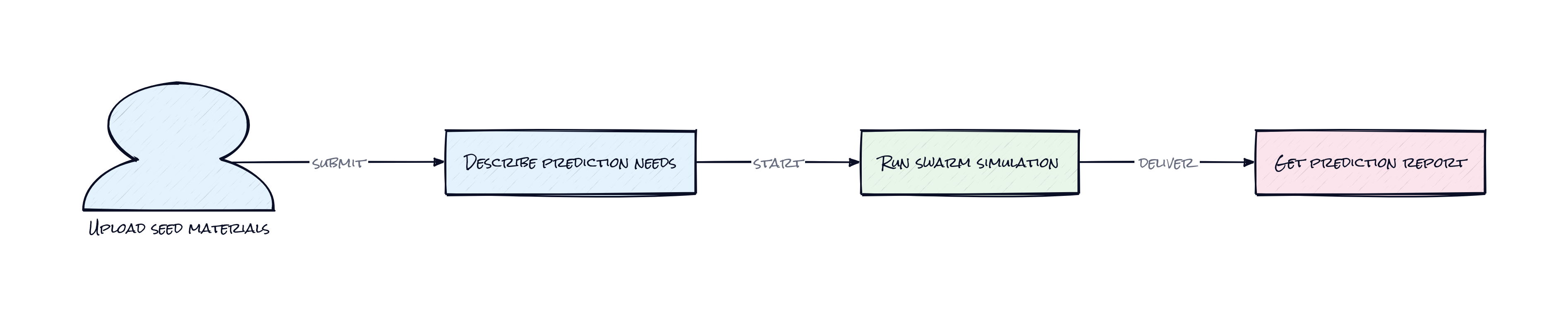
Traditional forecasting tools usually stop at dashboards, sentiment charts, or one-shot model outputs. Useful, sure, but they flatten the thing that actually matters: people react to other people, narratives mutate across platforms, and memory changes behavior over time. A public opinion crisis does not unfold as a neat line graph. Neither does a policy announcement or a speculative market story.
MiroFish is chasing the frustration behind that mismatch. Teams can already summarize news, scrape social chatter, and ask an LLM for scenarios. What they cannot easily do is stage a living rehearsal, where actors have motives, prior beliefs, and social ties that keep shaping the next round. That missing layer is why so many “prediction” products feel cosmetic. They describe the present in cleaner language, but they do not stress-test the future.
What makes this repo feel timely is that it treats forecasting less like analytics and more like simulation design. Feed in reports, news, or even fiction, and the system tries to construct a digital environment where collective behavior can emerge instead of being hard-coded. That is a much harder problem, and a much more interesting one.
The Stack: Python Runs the World Model
Under the hood, MiroFish pairs a Flask backend with a Vue frontend, with Python handling graph construction, agent setup, simulation control, and report generation. The architecture leans on OASIS for social interaction simulation, Zep for memory and graph storage, and any OpenAI-compatible LLM endpoint for reasoning, persona generation, and post-run analysis.
The Sauce: Memory Graphs Make the Swarm Plausible
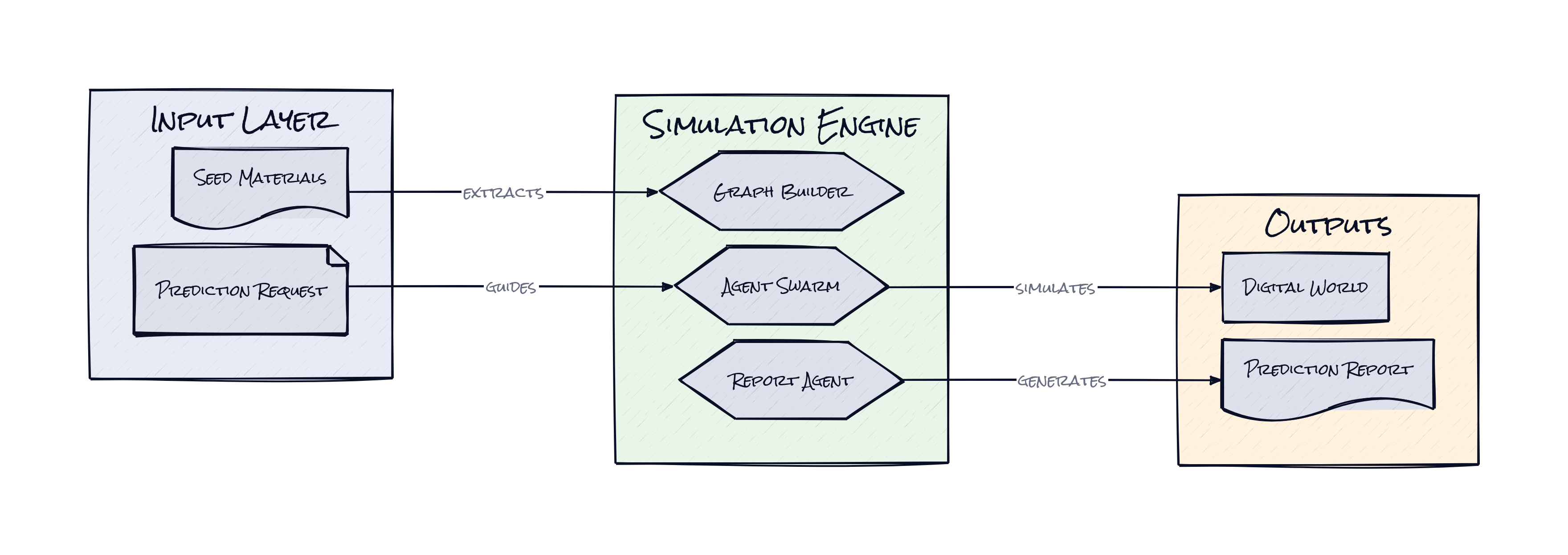
Here is the architectural bet: MiroFish does not just spawn a crowd of generic bots and ask them to roleplay. It first builds a GraphRAG layer from source material, then injects individual and collective memory into agents before the simulation starts. That distinction matters a lot.
A plain multi-agent setup often collapses into improv theater. Agents talk, but they do not have durable context beyond the prompt window, and they rarely share a coherent world model. MiroFish tries to fix that by constructing an ontology of entities and relationships, then using that graph as the substrate for personas, social ties, and evolving memory. In practice, that means an agent is not only “a student” or “a trader.” That agent exists inside a network of events, affiliations, prior interactions, and platform-specific dynamics.
Another smart choice is the dual-platform parallel simulation. Rather than model discourse as one blended stream, MiroFish can run environments that resemble different social systems, e.g. Twitter-like and Reddit-like behaviors, then watch cross-platform feedback emerge. That is way closer to how real narratives spread. Short-form outrage and thread-based deliberation produce different incentives, different pace, different amplification.
The final layer, ReportAgent, turns the aftermath into something queryable. Instead of dumping logs, MiroFish lets users inspect the simulated world, chat with agents, and ask follow-up questions about why a given trajectory happened. That makes the repo less like a prediction engine in the narrow sense and more like an explorable causal model. Whether the forecasts are truly accurate is still an open question. But as a system design, this is clever because it treats prediction as an interaction between memory, networks, and time, not just a better prompt.
The Move: Use It to Rehearse Decisions Before Reality Does
A strong use case here is not “predict anything,” even if the branding says that. The practical move is to use MiroFish where second-order reactions matter and cheap rehearsal creates edge. Communications teams can test how a sensitive announcement might spiral across different online communities. Investors and researchers can simulate how a policy draft or earnings rumor might reshape sentiment before the consensus forms. Creative teams can pressure-test story worlds, character arcs, or fandom reactions without waiting for live audience feedback.
Because MiroFish starts from uploaded seed material, the strategic advantage is context control. A team can anchor the simulation in its own reports, its own scenario assumptions, and its own risk factors, rather than relying on a general-purpose model that has shallow awareness of the domain. That makes the output more useful for planning, not just entertainment.
The deeper play is organizational. Once a company gets used to rehearsing launches, crises, and market narratives in a digital sandbox, decision-making starts looking different. Fewer static decks. More scenario loops. More pre-mortems backed by simulated social dynamics. That behavior, if it sticks, becomes hard to unwind.
The Aura: People Start Expecting Futures to Be Testable
Executives already expect dashboards for the present. Tools like MiroFish push toward expecting interactive previews of the near future too. That changes behavior. Instead of arguing abstractly about what might happen, teams can inspect a model, poke variables, and debate trajectories with something more concrete than instinct.
Culturally, that is a big deal. The repo suggests a world where “what if” becomes a standard interface, not a brainstorming ritual. Some of that will be overconfidence, obviously. Simulations can seduce people into believing the map is the territory. Still, the human pull is obvious: uncertainty feels less paralyzing when it becomes navigable.
The Play: Big TAM, Messy PMF, Serious Optionality
From a VC lens, MiroFish looks less like a simple better mousetrap and more like an early 0-to-1 wedge into simulation-native decision software. TAM spans enterprise comms, financial research, policy analysis, defense-adjacent planning, and creative tooling. The repo’s 64,584 stars are a loud signal of curiosity and strong top-of-funnel demand, though stars are not PMF. The real question is whether users come back for repeated scenario planning, because recurring behavior is where LTV shows up and where a moat can start forming.
The likely moat is not raw model access, because that gets commoditized fast. It is the combination of domain-tuned worldbuilding, accumulated scenario data, and workflow lock-in around decision rehearsal. If teams start storing assumptions, running counterfactuals, and comparing simulated versus real outcomes, switching costs rise quietly.
Winners:
Norm Ai: Faster policy and regulatory scenario testing compounds into better enterprise workflows, especially when simulation becomes part of compliance review rather than a one-off analysis.
Scale AI: Broader demand for synthetic social environments and evaluation loops expands from model benchmarking into decision simulation, increasing strategic relevance beyond labeling.
Palantir: Stronger appetite for operational digital twins in government and enterprise makes its ontology-heavy platforms easier to justify and stickier at high ACV.
Losers:
Rogo: Shallower finance copilots lose edge if buy-side teams start valuing simulated narrative propagation over polished retrieval and memo generation.
AlphaSense: Static research aggregation gets pressured when customers want scenario engines that can test outcomes, not just surface documents faster.
Cision: Legacy PR monitoring looks thinner if communications teams shift budget toward tools that rehearse crises before they erupt instead of measuring them afterward.
tl;dr
MiroFish turns reports, news, or fiction into a simulated social world where agents carry memory, interact across platforms, and generate forecast paths you can inspect afterward. The clever bit is the graph-and-memory architecture, not the chatbot layer. Worth a look for comms teams, researchers, investors, and anyone betting on scenario planning software.
Stars: 64,584 | Language: Python
