

The Push: June 26th, 2026
Private messaging without identities, AI code review before push, and one action layer for humans and agents


Simplex Chat: Privacy Without the Phone Number Trap
github.com/simplex-chat/simplex-chat | License: AGPL-3.0

Opening Signal messages someone from a real phone number. WhatsApp ties the entire graph to a contact list. Telegram claims privacy while quietly keeping usernames, handles, and server-side visibility in the loop. Simplex Chat goes after the part everyone has learned to tolerate, the metadata exhaust around messaging. Not just message content, but who contacted whom, when, and through what stable identity. That sounds abstract until a data leak, subpoena, or hacked contact graph turns “just a messenger” into a social map of your life.
The Drop: Messaging’s Identifier Problem

Plenty of chat apps already encrypt the text itself. The ugly gap sits one layer higher. A phone number, username, public handle, or account ID becomes the durable anchor for everything else: discovery, spam, moderation, growth loops, and surveillance. Once that anchor exists, the network can always correlate behavior across time.
Simplex Chat was built for the cases where that tradeoff feels unacceptable, e.g. journalists talking to sources, communities coordinating under pressure, or regular people who simply do not want every conversation attached to a reusable identity. Signal protects content well, but it still knows there is an account. Discord gives communities reach, but practically runs on persistent identity. Even Matrix, for all its openness, generally keeps user IDs front and center.
That is the frustration here. Privacy apps often stop at encryption while leaving the social graph half exposed. Simplex Chat asks a harsher question: what if the network never needed a user identifier at all? That design choice sounds almost inconvenient, and honestly, that is why it matters.
The Stack: Haskell in Service of Paranoia
Under the hood, Simplex Chat is powered primarily by Haskell, with native clients spanning iOS, Android, desktop, and terminal usage. The system combines end-to-end encryption with a double ratchet scheme for forward secrecy, plus relay-based messaging infrastructure and developer-facing client libraries for bots and integrations. It is a serious protocol project, not just a polished chat skin.
The Sauce: Connections Instead of Accounts
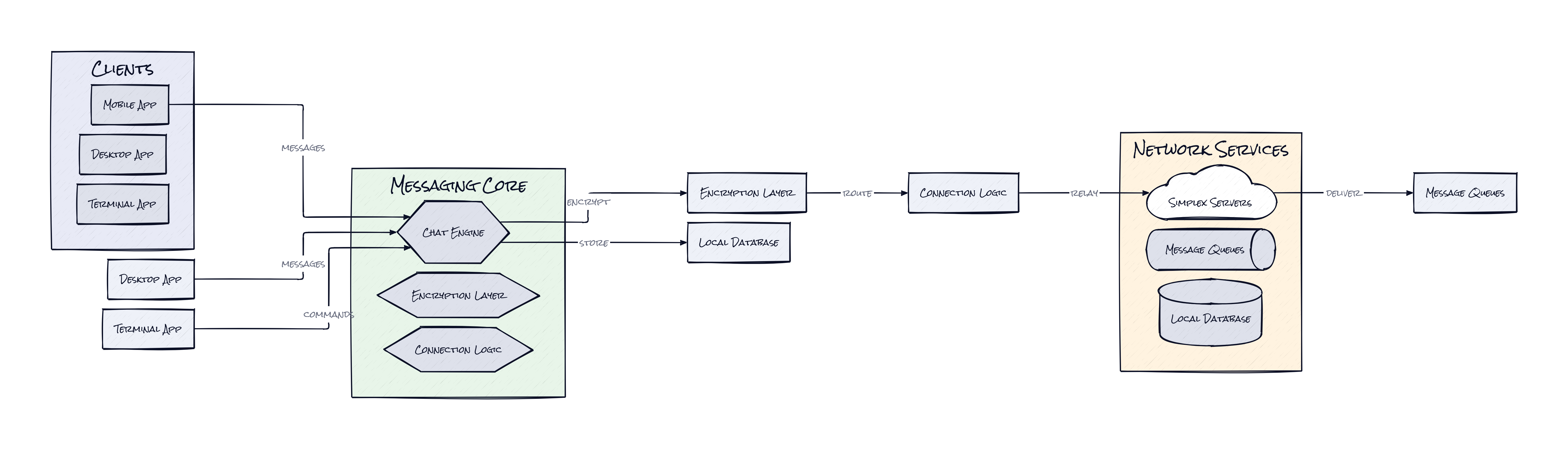
Unlike mainstream messengers, Simplex Chat organizes communication around one-time connection links, which establish a private relationship without creating a universal username, and message queues, which route traffic through servers without exposing a global identity layer. That architecture is the whole bet.
Here is why it is clever. A normal messaging network wants a stable account because stable accounts make everything easy: contact sync, search, re-engagement, ranking, abuse controls. Simplex Chat refuses that convenience. Each relationship is established directly, often by scanning a QR code or sharing a link over any channel where sender authenticity can be confirmed. After that, conversation happens over separate queues for sending and receiving, mediated by servers that do not need to know the broader social graph.
The important detail is not just encryption. The interesting part is metadata minimization as a network primitive. Servers can relay packets without holding the equivalent of “Alice talks to Bob every Tuesday at 9.” That sharply reduces the platform’s ability, and an attacker’s ability, to reconstruct a user graph. Add transport isolation, where connections are segmented rather than tied to one reusable ID, and the result looks less like WhatsApp with better PR and more like a different category of messaging system.
There are tradeoffs. Discovery is harder. Virality is weaker. Abuse handling gets messier. But that friction is the price of making the network itself know less. That is the point.
The Move: Where This Actually Becomes Useful
Teams dealing with sensitive outreach can put Simplex Chat to work immediately as a parallel communications layer, not a wholesale Slack replacement. Think investor backchannels, whistleblower intake, activist coordination, legal intake, executive comms during incidents, or customer support flows where identity collection is a liability instead of an asset.
Founders and operators should notice the strategic angle. Simplex Chat is not only an app, it is a protocol and tooling base for building privacy-first communications into other products. A marketplace could offer anonymous buyer-seller negotiation. A health startup could support protected peer groups. A media company could run source submission channels without turning every participant into a database record. The repo even exposes client and bot interfaces, which means product teams can build workflows on top rather than treating privacy as a sealed black box.
Adoption probably works best at the edges first. Start with high-risk conversations, cross-org projects, or communities where pseudonymity is not enough. If the operating assumption is that every identifier eventually leaks, Simplex Chat gives organizations a way to lower that blast radius by design, not by policy memo.
The Aura: When Contactability Stops Being Ownership
People have quietly accepted that being reachable means being legible. Sign up, verify a number, expose a handle, build a graph, and hope the platform behaves. Simplex Chat breaks that expectation. Contact becomes something granted per relationship, not something permanently owned by a network.
That changes behavior in subtle ways. Conversations can be more situational, less performative, less tied to maintaining a persistent online self. There is a philosophical edge here too: digital identity has been treated as mandatory infrastructure, when in many cases it is just a profitable default. Private by design starts to mean the system remembers less about you in the first place.
The Play: Privacy as Infrastructure, Not Feature Copy
This looks less like a better mousetrap for chat and more like a 0-to-1 attempt at rebuilding messaging around metadata resistance. TAM is broad because secure communication touches consumer chat, enterprise incident response, healthcare, media, and civil society, but monetization is tricky because growth loops are intentionally weak. PMF signals are real enough, 12,000 plus stars, multi-platform shipping, security-minded community validation, and active bot tooling suggest this is not a toy. The moat is not data or network effects in the usual sense. It is protocol design credibility, trust, and execution against a hard product constraint that bigger platforms have little incentive to copy cleanly.
Winners:
Nivenly: Lower-friction private community coordination gets more credible, and that compounds because trust-sensitive groups care more about governance than mainstream growth loops.
Skiff: Greater demand for privacy-native collaboration stacks strengthens the case for bundling secure communication with encrypted workspace products.
Cloudflare: More privacy-preserving traffic and relay-style architectures increase demand for edge infrastructure that can handle secure routing at internet scale.
Losers:
Beeper: Cross-network messaging loses some appeal when the highest-trust use cases increasingly want fresh private channels instead of unified identity layers.
Discord: Persistent-handle communities look weaker for sensitive coordination, because identity-centric chat is exactly the thing some users are trying to avoid.
Meta: Contact graph monetization erodes at the margin when users and organizations start treating phone-number-based messaging as an unnecessary exposure.
tl;dr
Simplex Chat turns messaging into a relationship-by-relationship network with no global user identifiers, which is far more interesting than “yet another encrypted app.” The clever part is the queue-based architecture that hides social graph data from the platform itself. Worth a look for founders, security teams, community operators, and anyone building trust-sensitive communication flows.
Stars: 12,194 | Language: Haskell
