



PM Skills: Product Management Gets Compiled
github.com/phuryn/pm-skills | License: MIT

A product manager opens ChatGPT for a PRD, Claude for strategy, a spreadsheet for prioritization, a Miro board for discovery, then ends up with five polished artifacts and one nagging problem: none of those tools actually enforce good judgment. PM Skills lands on that exact pain. Instead of asking AI to freestyle product work, this repo packages the workflows, heuristics, and prompts into something closer to an operating layer. That distinction matters. The frustrating part of AI for PMs was never writing faster. It was getting structured thinking on demand.
The Drop: Generic AI Was Never the PM Tool
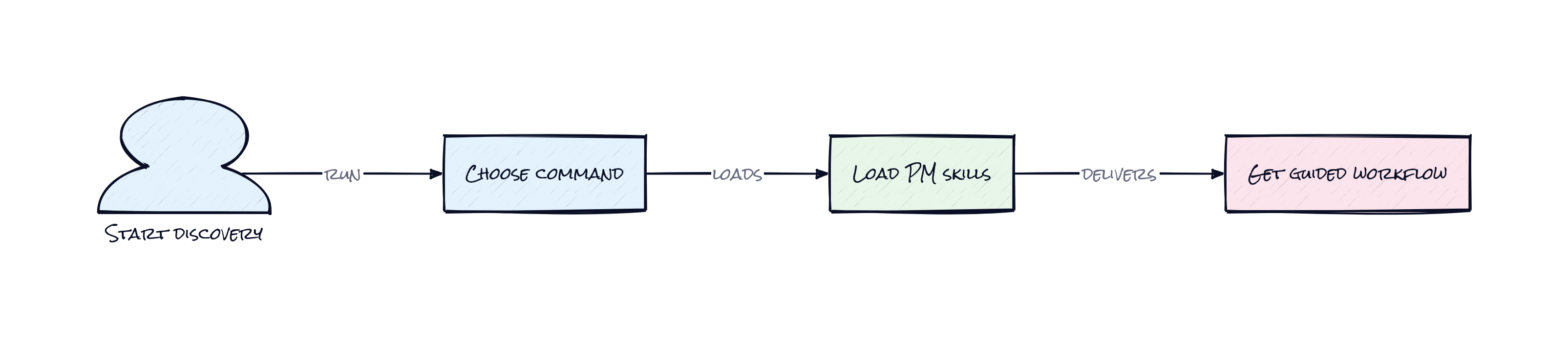
Plenty of AI products claim to help with product work, but the usual result is suspiciously competent mush. A market analysis appears. A roadmap appears. A launch plan appears. Yet the reasoning underneath often feels shallow, because the model is responding to a broad request instead of following an actual product method.
PM Skills Marketplace was built for that gap. The repo bundles more than a hundred skills, commands, and plugins across discovery, strategy, execution, research, analytics, growth, go-to-market, and even AI shipping. The useful idea is not “AI for PMs.” That phrase already means everything and nothing. The useful idea is encoding repeatable frameworks, then exposing them as reusable building blocks and chained workflows.
That matters because product work is sequential. Discovery should feed assumptions. Assumptions should feed experiments. Strategy should shape prioritization. A decent PM already knows this, but generic chat interfaces flatten every task into a blank text box. Commands restore sequence by turning multi-step processes into explicit flows, while plugins organize those flows into installable domains. Suddenly AI stops acting like an eager intern and starts acting more like a practiced operator with a playbook.
The Stack: Markdown as Product Infrastructure
Under the hood, this is refreshingly lightweight. Universal skill format markdown files hold the domain knowledge and workflow instructions, grouped into plugin manifests that Claude Code, Claude Cowork, Codex, and other assistants can read with minimal translation.
Python shows up mainly for validation, checking manifests, frontmatter, references, and documentation consistency. That choice feels deliberate. The product is the structure, not some flashy runtime.
The Sauce: The Marketplace Is the Architecture
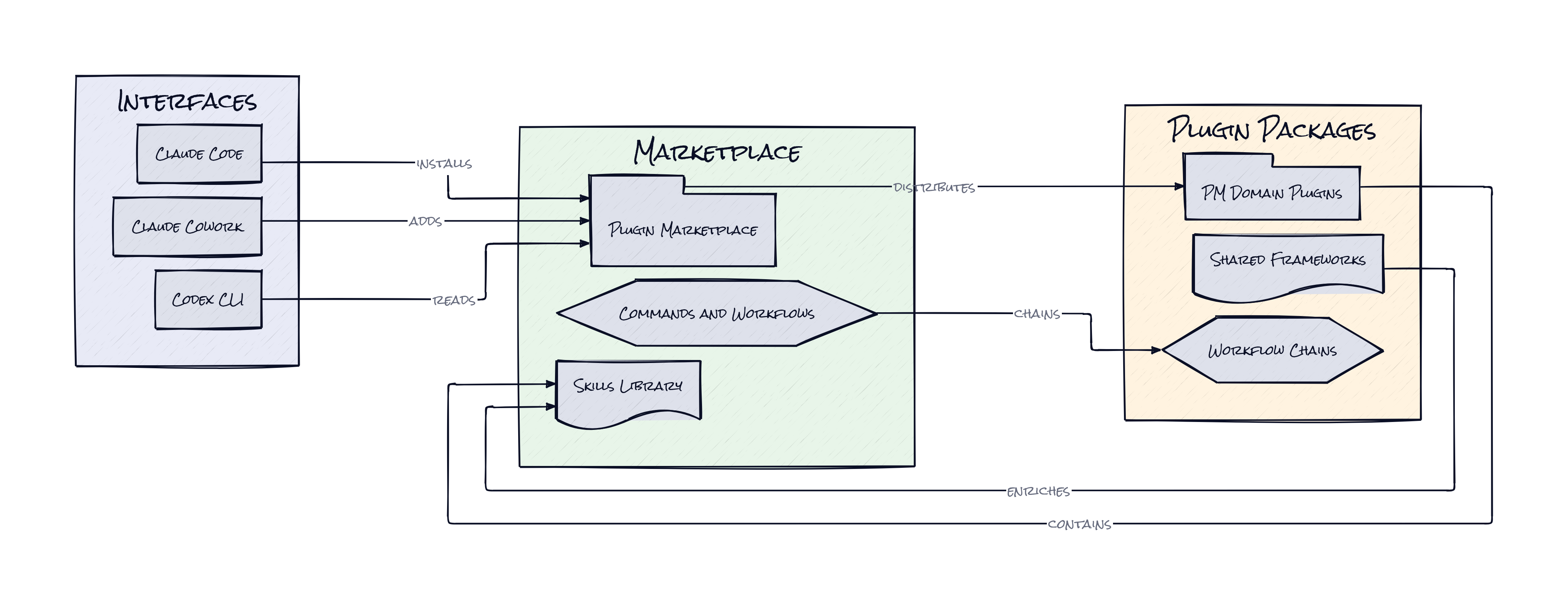
What makes PM Skills interesting is the three-layer design: Skills, Commands, and Plugins. Skills are the atomic units, focused frameworks like assumption mapping, opportunity solution trees, cohort analysis, or interview scripting. Commands chain those units into end-to-end workflows, e.g. discovery or launch planning. Plugins package related capabilities into domains that can be installed together.
That sounds tidy, but the architectural payoff is bigger than tidy. This repo treats product management knowledge as composable infrastructure. A single skill can be invoked implicitly when relevant, explicitly when needed, or reused across multiple workflows. That means the knowledge layer is not trapped inside one giant monolithic prompt. It behaves more like a modular service layer for reasoning.
The other smart move is cross-assistant portability. Claude gets the richest experience because it can expose slash commands directly, but the same skill files work in Codex and other assistants that understand the format. In practice, that creates a weirdly powerful abstraction: the PM methodology becomes portable even when the interface changes. That is the interesting part. Not another AI wrapper, but a durable content architecture that sits above any single model vendor.
There is also a subtle network effect hiding here. As more workflows get encoded, adjacent tasks become easier to connect. Discovery can naturally flow into PRDs, then into launch plans, then into metric design. Each new component increases the value of the others, because the repo is building a graph of product work, not a loose prompt pack. Think Notion templates, but with execution logic and model-aware loading built in.
The Move: Turn PM Judgment Into a Repeatable Surface
Founders, PMs, and strategy leads can use PM Skills as a decision-quality upgrade, not just a productivity trick. Start with one high-stakes workflow that usually suffers from inconsistency, e.g. early-stage discovery, feature request triage, or launch planning. Install the relevant plugin set, then run the same command every time that class of problem appears. Consistency is the point.
Teams also get a second-order advantage: shared operating language. When one person uses a structured discovery flow and another uses a different mental model every week, alignment gets expensive. PM Skills turns frameworks into defaults. A startup can standardize how assumptions are identified, how experiments are proposed, how roadmaps are stress-tested, and how metrics are framed, without buying an enterprise product suite.
Another strong use case is AI-native PM onboarding. New hires rarely fail because they cannot write documents. They fail because tacit product judgment takes years to absorb. This repo externalizes a chunk of that judgment into reusable workflows. Honestly, that could make small teams punch above their headcount. Less reinvention, fewer vague prompts, more repeatable thinking.
The Aura: Expertise Stops Living in PDFs
Product frameworks usually live in books, internal docs, workshop slides, and senior people's heads. Then everyone acts surprised when teams skip the hard thinking and ask AI for a polished answer. PM Skills changes the expectation. Knowledge does not just sit there waiting to be remembered, it becomes callable.
That has a quiet psychological effect. Structured judgment starts to feel available in the moment of work, not reserved for offsites or the most experienced person in the room. People begin to expect software to guide reasoning, not just generate output. That is a bigger behavioral shift than another chatbot feature.
The Play: PM Knowledge Becomes Software
This looks less like a 0-to-1 market creation and more like a sharp wedge into the massive PM tooling and AI copilot TAM. The PMF signal is real enough to pay attention to, 14,544 stars on a young repo, broad workflow coverage, cross-platform compatibility, and a contribution-friendly structure that invites community expansion. The moat is not deep model IP. It is execution speed, encoded domain expertise, and potential workflow lock-in once teams standardize around these patterns. If usage moves from solo experimentation to team ritual, LTV gets interesting and CAC can stay low through open source distribution.
Winners:
Aboard: Distribution gets cheaper because lightweight PM copilots can piggyback on open workflow standards instead of building every framework from scratch, and that compounds into faster product iteration.
Linear: Workflow depth gets stronger if planning, PRDs, and launch motions plug into structured AI reasoning, making project management harder to rip out once embedded.
Atlassian: Ecosystem gravity increases because Jira and Confluence can absorb modular AI guidance layers faster than closed PM suites can rebuild community momentum.
Losers:
Tana: Differentiation erodes if “structured thinking” turns into portable skills rather than a proprietary workspace behavior, and adaptation is hard when the format lives outside the product.
Airtable: General-purpose flexibility loses some appeal when opinionated PM workflows become installable and reusable with lower setup cost.
Asana: Premium planning value gets squeezed if AI-native workflow orchestration lives above task systems and turns execution software into a thinner system of record.
tl;dr
PM Skills turns product management frameworks into portable AI skills, chained workflows, and installable plugins. The smart part is the architecture: reusable reasoning blocks that work across assistants instead of living inside one giant prompt. PMs, founders, and AI tool builders should look closely.
Stars: 14,544
