

The Push: July 4th, 2026
Retro libraries, browser-native AI clicks, and private meeting notes—all the clever self-hosted polish this issue


RomM: Steam for Your Retro Hoard
github.com/rommapp/romm | License: AGPL-3.0
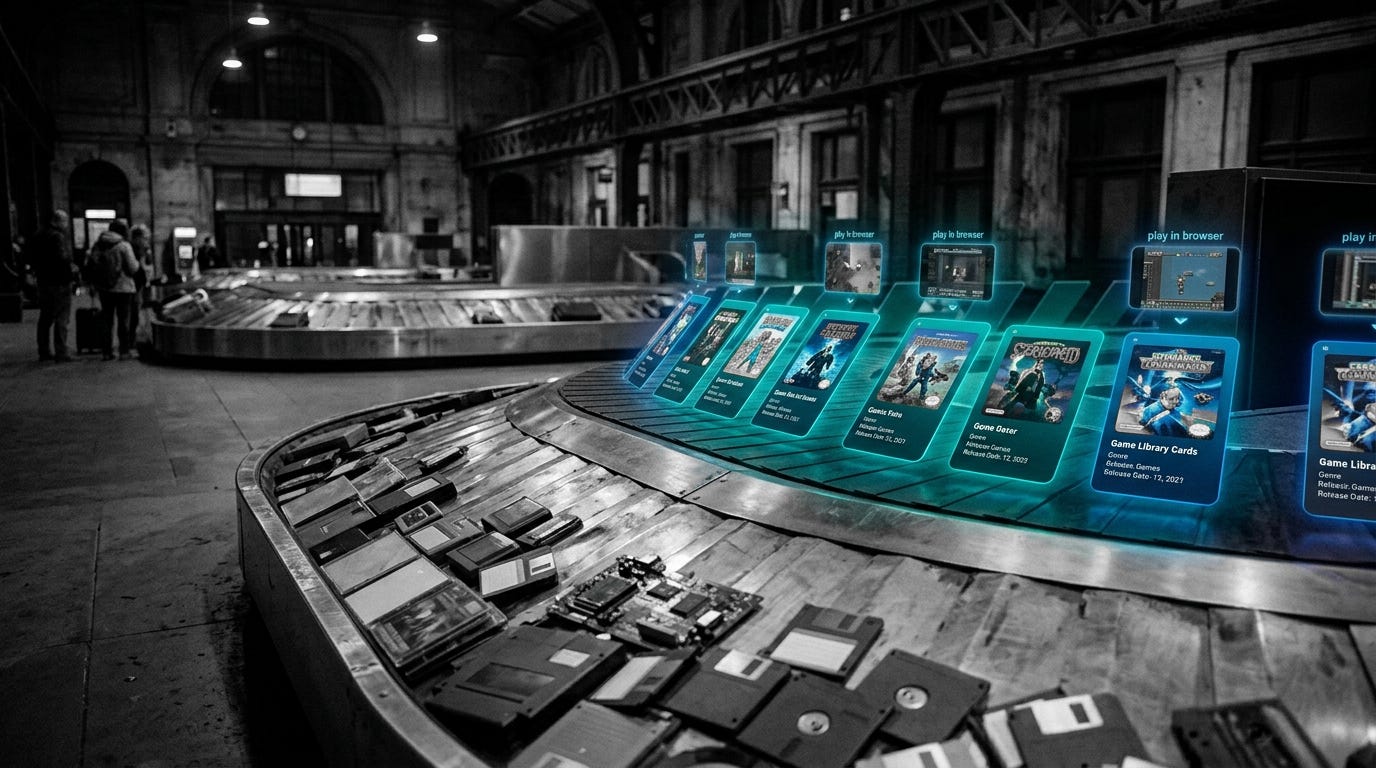
A retro game collection usually starts as a folder and ends as a mess. File names are weird, box art is missing, save states live on random devices, and the only person who understands the system is the one who built it three hard drives ago. RomM lands on that exact pain point. Instead of treating ROM libraries like archival junk drawers, it treats them like media collections that deserve structure, metadata, syncing, and a clean front end. Honestly, that framing alone explains why this repo crossed 10,000 stars.
The Drop: When Emulation Outgrows the Folder
Plenty of people have the content. Very few have the system. That is the gap RomM goes after.
The frustration is not just finding ROMs, it is managing everything around them once the collection gets serious. A handful of games can live in local folders without drama. A few hundred across handhelds, consoles, arcade boards, hacks, translations, multi-disk releases, manuals, and save files becomes an ops problem. Metadata breaks. Naming schemes drift. Artwork looks inconsistent. Saves get stranded on a Steam Deck, a phone, or a handheld running custom firmware. Sharing a collection with friends usually means some awkward combination of cloud folders and caveats.
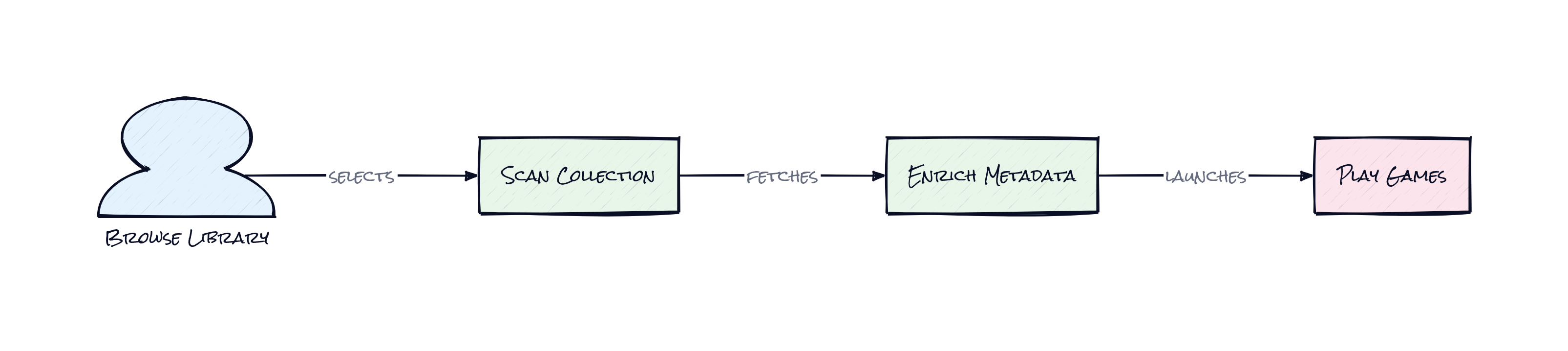
RomM takes that pile and turns it into a browsable, playable library with search, tagging, metadata enrichment, achievements, and browser playback. The interesting thing is not that retro gamers want a prettier interface. Plex already proved that people want beautifully indexed personal media. The real gap was that emulation never had a similarly polished control layer for the long tail of game files and device sync. RomM fills that gap with surprisingly strong product instincts.
The Stack: Python Running the Arcade Cabinet
Under the hood, RomM is a FastAPI app written in Python, with a web front end and a self-hosted deployment story built around Docker. Browser play comes from EmulatorJS and RuffleRS, while metadata and artwork are pulled from services like IGDB, Screenscraper, MobyGames, SteamGridDB, and RetroAchievements.
The Sauce: Metadata as the Product Surface
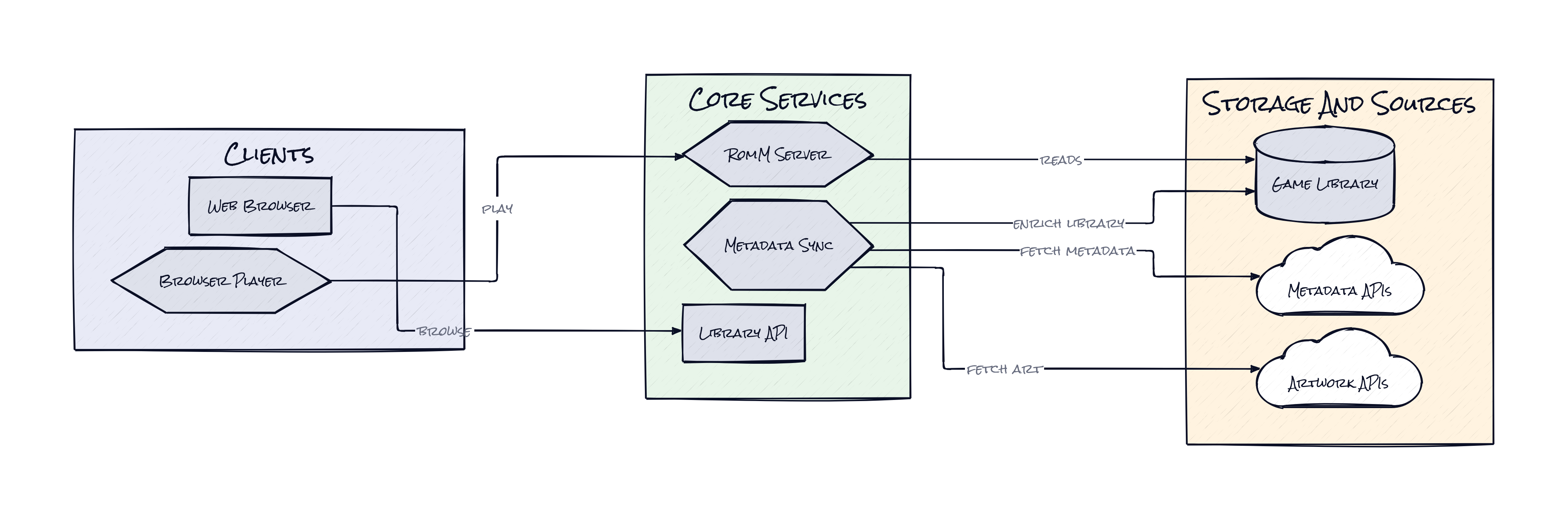
Plex solved movies because movies already have stable identities. Retro game files do not. RomM gets interesting because it builds a metadata enrichment pipeline that turns messy file collections into a consistent library model, then layers playback, sync, and discovery on top of that model.
That sounds obvious, but it is a pretty sharp architectural choice. RomM does not just store files and show them in a grid. The system scans collections, parses naming conventions and tags, connects each game to external metadata providers, pulls in covers and artwork, attaches achievement data, and normalizes all of that across more than 400 platforms. In other words, the file is not the product unit, the enriched game entry is.
That decision unlocks a lot. Once the collection becomes a structured catalog, RomM can support browser play, permissions, handheld clients, Playnite integration, activity tracking, save management, and even conflict-aware syncing across devices. The codebase hints at this broader shape with watchers, sync handlers, task queues, and lots of service adapters. Those pieces matter because retro libraries are living systems, not static archives.
Even better, the project seems to understand that aesthetics are infrastructure here. The interface is polished because trust in a personal library comes from legibility. If every game looks complete, labeled, and playable, the collection feels reliable. That is a smarter bet than obsessing over emulation internals alone. RomM wins by making organization itself feel premium.
The Move: Turn Hobby Chaos Into Owned Distribution
Collectors can use RomM as a personal dashboard, sure, but the stronger move is treating it like a private distribution layer for retro gaming across devices. That changes the job from “manage files” to “operate a library.”
Set up RomM on a home server or NAS, point it at the collection, connect metadata providers, and let the platform build a searchable catalog with artwork, platform grouping, and achievements. Add browser playback for quick sessions, then connect companion clients on Android, SteamOS handhelds, or desktop launchers. Suddenly the same library is available across contexts without manually curating each device.
Shared access is where the strategy gets more interesting. Friends or family can browse selected parts of a collection with limited permissions, which turns RomM into a lightweight personal game service rather than a private archive. For creators, curators, or retro communities, that opens a niche but real use case: themed collections, event libraries, preservation showcases, even classroom-style setups around gaming history.
The advantage is not convenience alone. It is control. No storefront lock-in, no subscription catalog churn, no platform deciding what counts as your library. RomM gives retro gaming the same owned-media confidence that self-hosted music and video people have been chasing for years.
The Aura: Ownership Gets a Better Interface
People tolerate a lot of disorder when software makes ownership feel tedious. RomM chips away at that. A collection stops feeling like digital baggage and starts feeling like a maintained personal asset.
That shift matters beyond retro games. Expectations are changing around what personal software should do: remember context, sync across devices, present information beautifully, and stay under the user's control. RomM quietly argues that self-hosted does not need to mean ugly, fragile, or antisocial. It can mean polished, shareable, and dependable. That is a bigger psychological unlock than emulation itself.
The Play: Niche Media, Serious Retention
From a VC lens, RomM is not a pure 0-to-1 category creation. It is a better mousetrap in a proven market pattern: self-hosted media servers with strong emotional attachment and very low churn. The TAM is narrower than Plex or Spotify-scale media, but the users are intense, collector-minded, and willing to invest time, hardware, and community energy. More than 10,000 stars, an active companion app ecosystem, and integrations across handhelds and launchers are decent PMF signals for an open source infrastructure play.
The moat is not raw code. Execution speed and community surface area matter more here. Once a library is enriched, tagged, synced, and connected to multiple devices, switching costs rise fast because the user has trained a whole personal workflow around the stack. That behavior is sticky in the same way homelab and NAS software tends to be sticky.
Winners:
RetroDECK: Distribution gets easier because RomM can become the library back end behind a cleaner handheld experience, and that compounds as more users expect cross-device sync by default.
Anbernic: Hardware appeal rises when buyers can plug into polished self-hosted libraries instead of fiddling with SD card chaos, which boosts perceived product quality without owning the software layer.
Synology: Home server relevance deepens because projects like RomM turn NAS boxes into consumer media platforms, increasing LTV through software-driven use cases.
Losers:
Antstream Arcade: Subscription value erodes when self-hosted collections become easier to browse, sync, and play across devices, making paid access feel less necessary for enthusiasts.
Plex: Expansion optionality into gaming media looks weaker because RomM shows a focused product can own the collector workflow better than a broad media incumbent.
Nintendo: Virtual Console-style nostalgia monetization gets softer at the margins when user expectations shift toward permanent, portable libraries they control themselves.
tl;dr
RomM turns a scattered retro game collection into a polished, self-hosted library with metadata, browser play, device sync, and sharing. The clever part is the enriched catalog layer that makes ROM files behave more like a real media platform. Retro collectors, handheld tinkerers, and homelab people should look.
Stars: 10,040 | Language: Python
