

The Push: July 3rd, 2026
Infra scripts, codebase memory, and safe AI sandboxes for teams wrangling drift, messy repos, and risky agents


Ansible: Servers Should Read Like Checklists
github.com/ansible/ansible | License: GPL-3.0
A deployment goes sideways at 11:40 p.m. One machine has the new package, three have the old config, two never restarted, and nobody is fully sure what changed because half the team used shell scripts and the other half clicked around a cloud console. That mess is older than AI hype, and still weirdly common. Ansible matters because it turned infrastructure work into something reviewable, repeatable, and plain enough that operations logic can live in a document instead of in one stressed person's head.
The Drop: Ops Broke Because Memory Was the Interface
Plenty of infrastructure pain comes from a simple fact: computers are consistent, but the way humans manage them usually is not. One admin SSHs into a box and edits a file by hand. Another copies a command from an old wiki. A third uses a cloud dashboard and forgets what was toggled. Suddenly "production environment" is less a system and more a pile of folklore.
Ansible was built for that exact gap. Teams needed a way to describe the desired state of machines, apps, network gear, and cloud resources without shipping a heavyweight agent to every server or writing custom automation code for every change. The frustration was not just speed, it was trust. Could anyone look at a deployment plan and know what would happen before running it? Could a new machine be brought into line without a week of setup debt?
That is why Ansible stuck. It gave operations teams a shared language for change, one that reads closer to intent than code. Honestly, the pain point was never "servers are hard." The pain point was that infrastructure knowledge kept hiding in terminals, tribal memory, and brittle scripts.
The Stack: Python With a Huge Adapter Surface
Under the hood, Ansible is primarily Python, with YAML as the human-facing layer for automation documents and a broad plugin architecture that connects to servers, clouds, network devices, and secrets systems. SSH is the default transport, and the surrounding ecosystem includes Ansible Galaxy, a distribution hub for reusable collections of modules, roles, and integrations.
The Sauce: Agentless Was the Product Decision
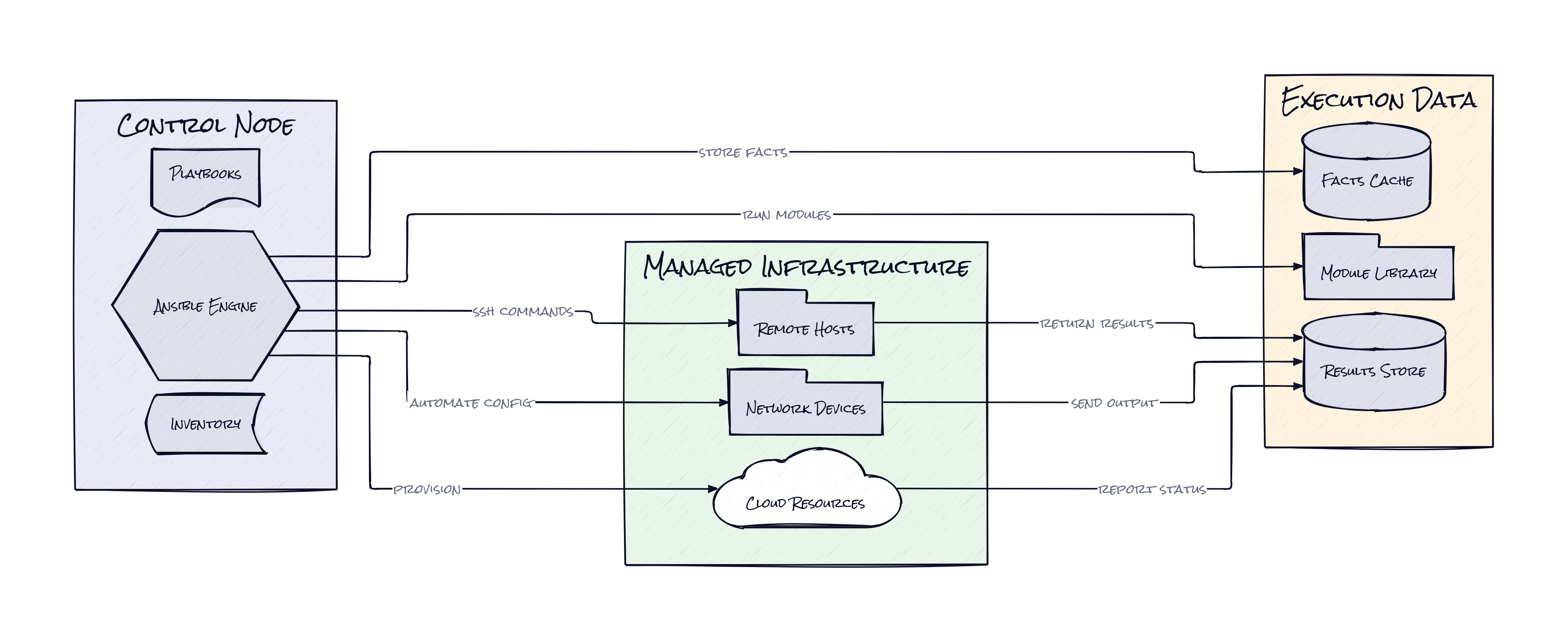
Unlike a lot of infrastructure automation tools, Ansible made agentless control the center of the architecture. That sounds small until the implications click. Instead of requiring software to be preinstalled and constantly maintained on every machine, Ansible treats existing access methods, usually SSH, as the execution rail. The controller machine carries the orchestration logic, connects outward, runs tasks, checks results, and moves on.
That choice changes adoption math in a big way. Fewer moving pieces means less bootstrapping, less security review, fewer version mismatches, and a much easier first run. A company can point Ansible at a fleet that already exists and start standardizing behavior immediately. No daemon rollout first, no "install this before automation can automate."
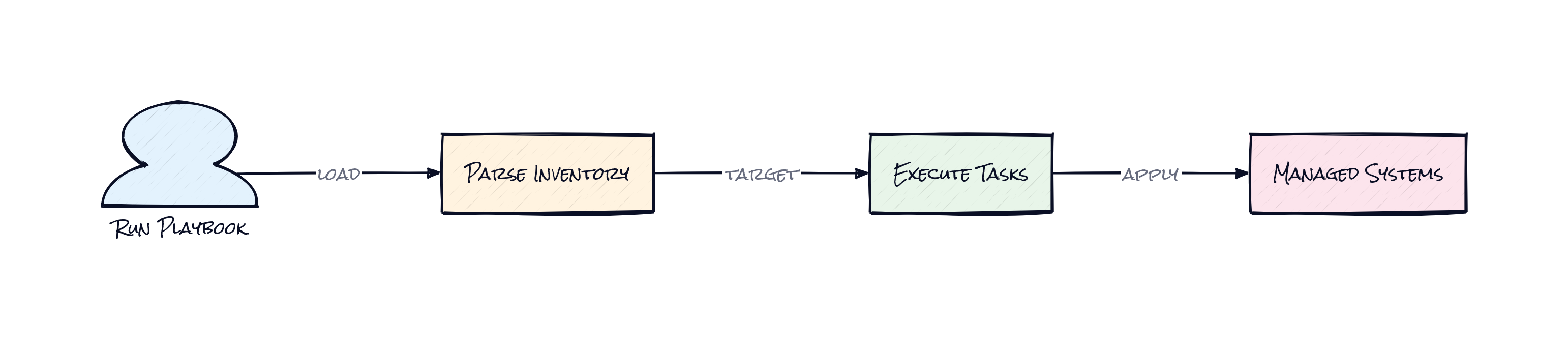
The deeper cleverness is how that transport model pairs with playbooks, declarative task documents that describe end state rather than just raw commands. Ansible then layers a massive module ecosystem on top, where each module knows how to handle one domain, e.g. packages, cloud instances, users, firewalls, databases. Combined with idempotence, the expectation that rerunning the same automation should converge on the same result rather than duplicate work, the system becomes less like scripting and more like policy execution.
That architecture aged surprisingly well. Even in a Kubernetes and Terraform world, plenty of real infrastructure still needs day-two operations, config drift cleanup, rolling changes, secrets handling, and one control plane that can touch Linux boxes, switches, and cloud APIs in the same workflow.
The Move: Turn Infrastructure Into a Reviewed Artifact
Start with the boring but expensive stuff. Server setup, package installs, user permissions, cron jobs, app deploy steps, config files, and restart logic are all perfect candidates. The win is not just automation, it is turning operational behavior into something product teams, security leads, and new hires can actually inspect.
From a strategy angle, Ansible is strongest when a company has mixed environments and human inconsistency is the tax. A startup moving from five cloud instances to fifty can use Ansible to standardize environments before drift becomes institutional. A larger company can use it to document operational intent across legacy systems, networking gear, and cloud services that do not live in one vendor stack.
Practical leverage comes from treating playbooks like living runbooks. Pair them with code review, tie them to incident postmortems, and keep them close to release workflows. That creates a compounding advantage: every outage fix, compliance requirement, or onboarding lesson becomes reusable automation instead of another Slack thread. That is the part that sticks, because muscle memory around manual ops is hard to scale, but reviewed automation scales very well.
The Aura: Reliability Stops Being Heroic
Midnight fixes lose some of their mystique when the recovery steps already exist as executable documents. That changes team psychology more than it seems. Fewer people need to be the irreplaceable operator with the magic commands, and more people can participate in shipping, maintaining, and auditing systems.
Ansible nudges organizations toward a quieter kind of competence. The expectation becomes, "show the process," not "trust the expert." On a human level, that is a move from operational hero culture to institutional memory. Less drama, more continuity. For companies trying to grow without turning every deployment into lore, that mindset is a serious upgrade.
The Play: Mature Category, Durable Wedge
This is not a 0-to-1 bet, it is a better-control-surface play in a huge existing TAM: infrastructure automation, compliance ops, cloud management, and enterprise orchestration. But "mature" does not mean commoditized. Ansible shows enduring PMF through massive adoption, 69,000-plus stars, deep community contribution, and years of production trust. The moat is not pure code, it is workflow embedding, ecosystem breadth, and switching costs created by thousands of existing automation documents inside real companies. CAC for a commercial layer on top can be efficient because the open source project already educates the market, and LTV gets boosted when automation becomes part of security, release, and audit processes.
Winners:
FireHydrant: Faster incident remediation compounds when operational runbooks become executable and reviewable, tightening the link between alerts and standardized recovery.
Wiz: Stronger cloud security posture compounds when infrastructure state can be continuously enforced, not just observed, across messy hybrid estates.
Red Hat: Deeper enterprise account stickiness compounds because Ansible remains a natural control plane inside broader platform, Linux, and hybrid cloud deals.
Losers:
Massdriver: Harder differentiation erodes when infrastructure orchestration becomes easier to standardize with incumbent open source habits that teams already trust.
Pulumi: Narrower expansion into day-two operations gets tougher because declarative infrastructure creation does not automatically own ongoing machine and config management.
VMware: More of the old enterprise operations premium weakens when software-defined automation reduces the need for proprietary management surfaces and manual admin workflows.
tl;dr
Ansible turns infrastructure work into readable, repeatable automation that runs over existing access rails like SSH. The smart part is its agentless architecture plus idempotent task model, which makes standardization easier to adopt and easier to trust. Teams dealing with cloud sprawl, compliance, or ops drift should pay attention.
Stars: 69,139 | Language: Python
