



Box3D: Physics Engines Still Matter
github.com/erincatto/box3d | License: MIT
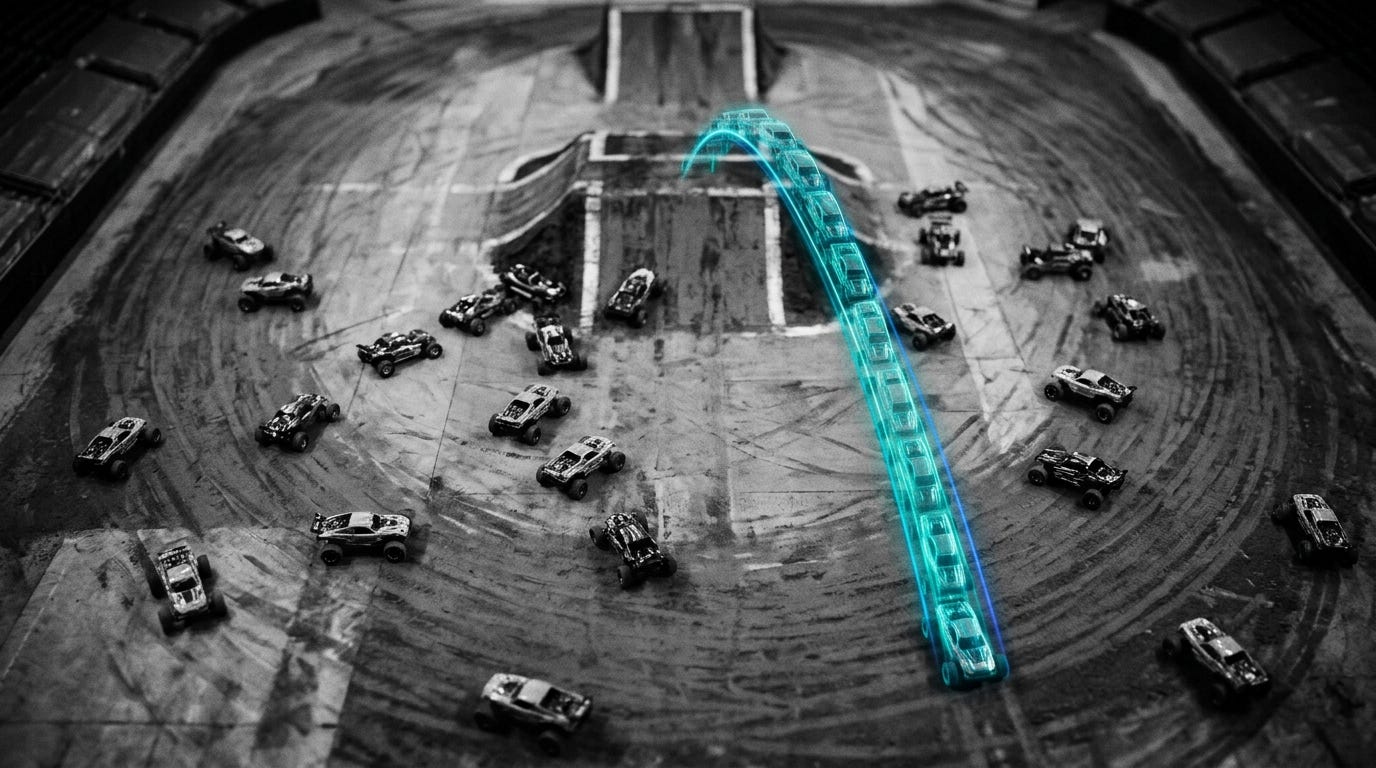
A falling crate is easy. A hundred crates, rolling down uneven stairs, colliding with a speeding vehicle, while still feeling fair to the player, is where games usually get exposed. Physics is one of those systems people only notice when it breaks, and broken physics instantly makes everything feel cheap. Box3D lands right in that pain point. This is a new 3D engine from the creator of Box2D, built for game simulation that needs to be fast, deterministic, and stable under pressure, not just pretty in a demo.
The Drop: When Good Games Feel Wrong
Plenty of 3D games look impressive right up until objects start clipping through walls, characters jitter on slopes, or fast-moving bodies tunnel straight past each other. That frustration is older than modern game engines, and honestly still not solved cleanly for a lot of teams. Physics in 3D gets expensive fast because every extra axis multiplies the number of weird edge cases, from stacked objects to rotating collisions to giant worlds that need consistent behavior across platforms.
Erin Catto built Box2D into one of the internet’s default answers for 2D physics because it balanced realism with predictability. Box3D seems driven by the same gap in 3D: teams want robust simulation without dragging in a giant engine stack or accepting flaky behavior that only appears at scale. The repo’s feature list reads like a checklist of things that routinely go wrong in shipping games, e.g. continuous collision detection, joint constraints, character movement, large body piles, replay, and cross-platform determinism. That combination matters because “works on one machine” is useless when a physics bug can desync multiplayer, break replays, or make creators lose trust in the tool.
The Stack: C With Performance Discipline
Under the hood, Box3D is written in portable C, with a data-oriented design that organizes memory around throughput instead of object-oriented elegance. The core library keeps dependencies basically nonexistent, while samples use sokol for graphics and imgui for inspection. SIMD and multithreading are first-class, not afterthoughts.
The Sauce: Stability Is the Product
What stands out here is Soft Step, the project’s rigid body solver, paired with an architecture clearly tuned for consistency under load. Physics engines live or die on the solver, because that’s the layer deciding how collisions, joints, friction, and motion all resolve frame after frame. Fancy rendering can hide a lot, but unstable constraint solving turns every stack of boxes into chaos.
Box3D combines continuous collision handling with a solver designed for large interacting systems, not isolated showcase objects. The important bit is how several choices reinforce each other. Cross-platform determinism means the same simulation should produce the same outcomes across machines, which is a huge deal for lockstep multiplayer, authoritative servers, competitive replays, and debugging. Recording and replay then turns that determinism into an operational tool, because the exact bad state can be captured and rerun instead of hand-waved away as “hard to reproduce.”
Another smart choice is the bias toward data-oriented design and large piles of bodies. That sounds dry, but it changes the engine’s behavior in practice. Memory layout, sleep systems, SIMD math, and island-based scheduling are all about keeping many-body simulations stable and fast when scenes get crowded. The result is not just raw speed. It is reliability at the exact moment game systems become messy, interconnected, and expensive. Honestly, that is the interesting part. Box3D is selling trust, not spectacle.
The Move: Where This Actually Wins
Indie studios, simulation startups, and anyone building physics-heavy interactive products can use Box3D as the foundation layer instead of inheriting whatever half-loved defaults come with a bigger engine. A small team making a multiplayer sandbox, robotics training sim, browser-based game, or UGC world could plug in Box3D and get deterministic simulation that is easier to benchmark, replay, and tune.
Founders should read this less as “another game engine component” and more as infrastructure for believable interaction. If the product depends on objects behaving consistently, e.g. vehicles, construction, destruction, sports, or creator-made worlds, then physics quality directly affects retention. Players rarely praise the solver, but they absolutely churn when movement feels slippery or collisions feel fake.
Studios also get a strategic option here: owning the simulation layer creates room to ship across native and web targets without tying core behavior to one platform vendor’s stack. That matters if the roadmap includes modding, esports, physics-authored content, or server-side validation. Box3D looks especially useful for teams that need a lean core and want control over gameplay feel, not just a black-box checkbox labeled physics.
The Aura: Believability Becomes Infrastructure
Players stop negotiating with broken worlds once interaction feels dependable. A barrel rolls like a barrel, a jump lands where instinct says it should, a replay shows what actually happened. That sounds subtle, but it changes expectations. Products built on solid simulation train users to trust systems more deeply, whether that system is a game, a training tool, or a virtual environment.
Clean physics also nudges creators toward richer behavior. When collisions, joints, and motion are stable enough, designers try riskier mechanics because the foundation no longer feels fragile. The human shift is simple: digital spaces start feeling less scripted and more inhabitable.
The Play: Picks and Shovels for Simulated Worlds
From a VC angle, Box3D is less a 0-to-1 category creation than a best-in-class core component in a very durable market. The TAM spans game studios, UGC platforms, simulation software, robotics training, and browser-native 3D apps. PMF signals look early but real: 5,700-plus stars in a short window, active discussions, and immediate interest driven by Erin Catto’s reputation. The moat is not data or network effects. It is execution quality, trust, and the compounding advantage of becoming the default physics layer teams build habits around. If that happens, switching costs become design-deep.
Winners:
Miru: Better simulation primitives can let a small UGC or game tooling startup ship richer physics-first experiences faster, and that compounds through creator retention.
Pragma: Stronger deterministic simulation improves backend-heavy multiplayer tooling, making replay, sync, and server authority more valuable to studios at scale.
Roblox: Cheaper access to credible open physics raises the ceiling for creator experiences and pressures the company to keep its own simulation stack ahead on quality and tooling.
Losers:
Rivet: Weaker differentiation hits early-stage browser game tooling if core physics quality becomes easier to source as open infrastructure.
Improbable: Harder enterprise storytelling follows when open deterministic simulation keeps getting better, especially for teams that do not need a massive proprietary platform.
Unity: More credible standalone middleware chips at engine bundling power, because studios gain confidence that key subsystems can be owned and swapped independently.
tl;dr
Box3D turns 3D game physics into a lean, deterministic, high-trust building block. What is clever is the combination of solver stability, replayability, and data-oriented performance, which makes simulation operationally reliable, not just visually plausible. Game studios, multiplayer teams, and simulation-heavy startups should look closely.
Stars: 5,704 | Language: C
