

The Push: July 2nd, 2026
Smarter repo grabs, caveman-terse AI, and a tag-team coding copilot that can review, argue, and jump in


Actions Checkout: CI’s Smallest Huge Dependency
github.com/actions/checkout | License: MIT

GitHub Actions feels magical right until a workflow fails before any real work starts. Build never runs. Tests never run. Deployment never runs. The repo simply is not where the runner expects it to be, or worse, the wrong code gets pulled into a privileged job. Actions Checkout sits in that boring-looking first step nearly everyone copies and forgets, which is exactly why it matters. The hidden truth of modern automation is that getting source code into the machine safely is not plumbing, it is policy.
The Drop: The First Step Was Doing Too Much
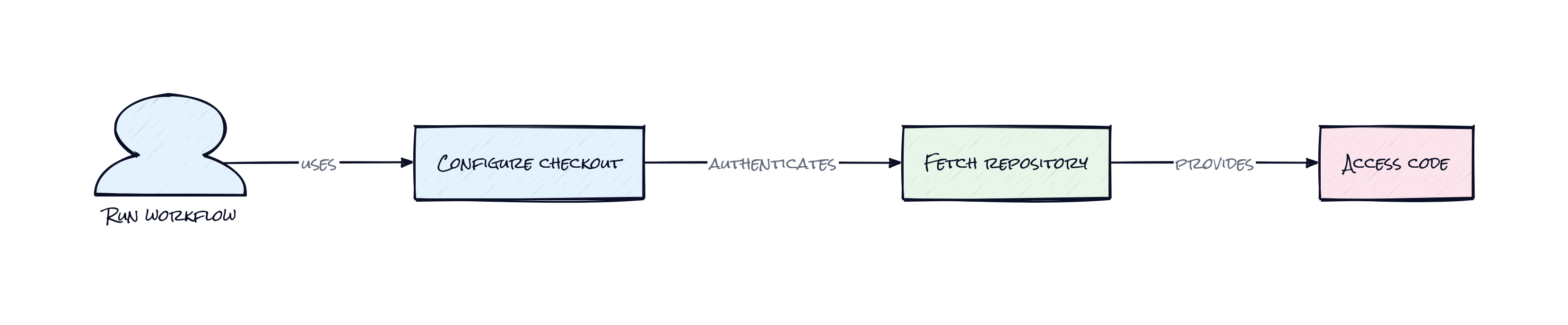
CI pipelines love to pretend cloning a repo is trivial. In practice, that first fetch has to answer a pile of messy questions: which commit, which branch, how much history, whether submodules come along, whether large files need downloading, whether credentials should stick around, and whether the event came from a fork that absolutely should not inherit trusted access.
Actions Checkout exists because the default “just run git clone” story breaks fast inside ephemeral runners. Workflows need the exact ref that triggered the event, not whatever happens to be latest. Monorepos want sparse checkout, meaning only selected folders get pulled down instead of the whole tree. Release jobs may need tags and full history, while test jobs want the smallest possible fetch for speed. Enterprise installs complicate it further with custom GitHub domains and locked-down environments.
Then there is the ugly part, security. GitHub had to encode guardrails against “pwn request” style mistakes where privileged workflows accidentally execute forked code. That is the frustration underneath this repo: automation starts with code retrieval, but code retrieval is entangled with trust, performance, and context. Boring? Only until it fails.
The Stack: TypeScript Wrapped Around Git Reality
Under the hood, Actions Checkout is a TypeScript GitHub Action running on the standard Actions toolkit, with dependencies like `@actions/core`, `@actions/exec`, and Octokit helpers for API fallback behavior. The architecture mixes direct Git commands with GitHub API downloads when local Git capabilities are limited, which is a very pragmatic design for heterogeneous runners.
The Sauce: Policy Encoded as a Checkout Primitive
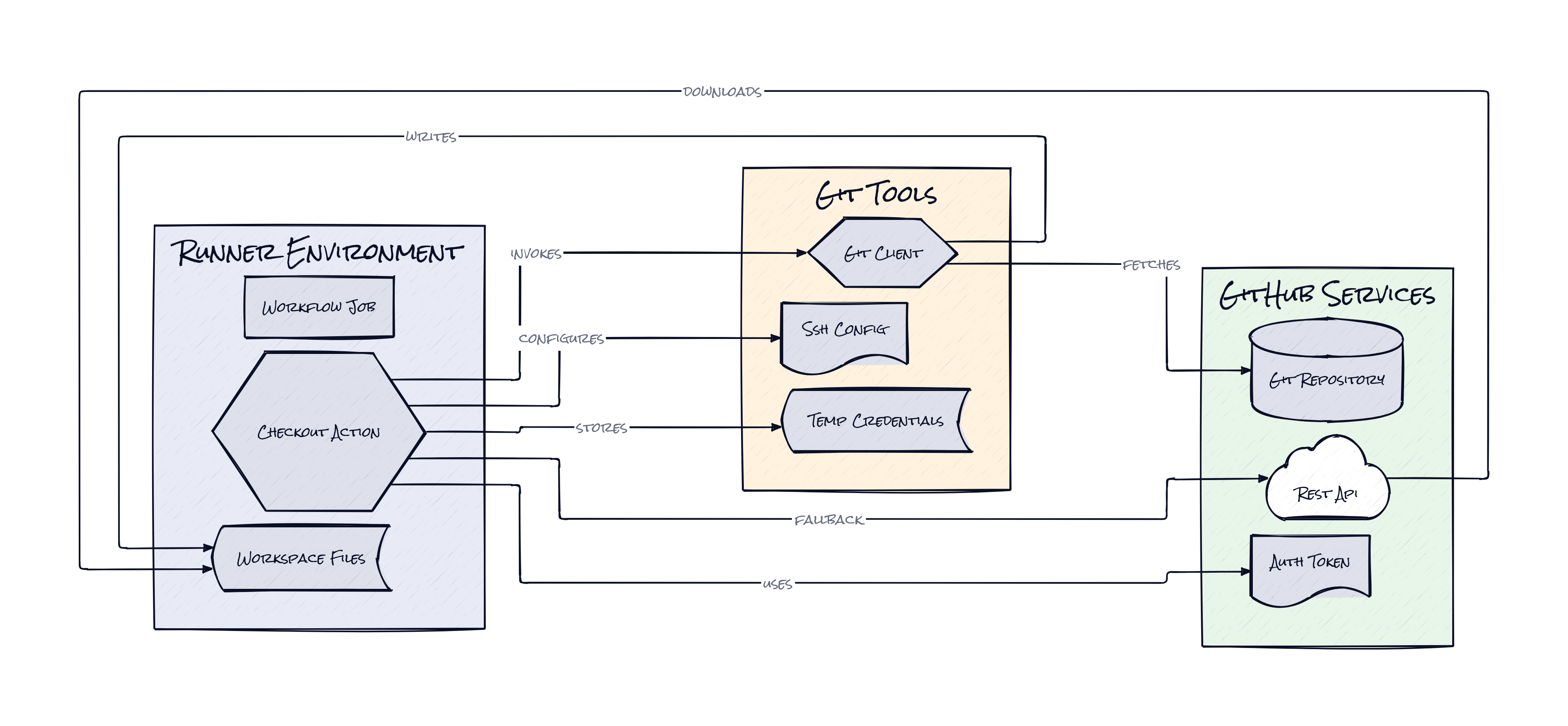
One architectural choice gives Actions Checkout its weight: the project treats repository retrieval as a context-aware source provider, not as a thin wrapper around clone commands. That sounds subtle, but it changes everything.
A normal clone tool asks, “What URL and ref?” Actions Checkout asks a broader set of questions tied to workflow state: what event triggered this run, what credentials are available, whether the workspace already exists, whether the runner supports modern Git features, whether persist-credentials should survive for later authenticated commands, and whether a risky pull request context should be blocked unless explicitly allowed. In other words, checkout becomes an orchestration layer for trust and reproducibility.
That design shows up in a few smart places. First, the action defaults to shallow fetches, a speed optimization that matters at GitHub scale because millions of workflows do not need full history. Second, it supports filter and sparse retrieval modes, letting teams pull only slices of giant repos. That is not just faster, it lowers bandwidth and startup cost for every automation job touching a monorepo. Third, there is a fallback path that downloads repository contents via the API when Git on the runner is too old, which keeps workflows resilient across uneven environments.
Honestly, the interesting part is not that Actions Checkout gets code onto disk. The interesting part is that GitHub packaged a set of operational and security opinions into the very first step of the pipeline. allow-unsafe-pr-checkout existing as an explicit opt-in says the quiet part out loud: source retrieval can be an attack surface, and the action treats that as a product concern, not a footnote.
The Move: Turn Pipeline Friction Into Operating Discipline
Teams can get more out of Actions Checkout than “copy the snippet from the docs.” The strategic move is to tune retrieval behavior to the job’s real purpose. For linting, docs builds, or UI previews in a monorepo, sparse retrieval can cut startup time and reduce runner waste. For release automation, fetching tags and full history avoids weird edge cases around versioning and changelog generation. For jobs that push commits back, keeping credentials available is useful, but only in tightly scoped workflows.
Founders and product teams should read this repo less as a utility and more as a checklist for CI hygiene. If workflows touch untrusted pull requests, the unsafe checkout guard should be reviewed immediately. If build times are creeping up, shallow fetch defaults and selective retrieval are easy wins. If internal tooling relies on GitHub Enterprise or custom infra, the server URL and fallback logic matter more than they seem.
A polished automation stack compounds through seconds saved and incidents avoided. The companies that feel “fast” in software delivery usually are not doing one magical thing. They are removing friction from every hidden layer, including the first one that grabs code.
The Aura: Trust Moves Closer to the Trigger
Developers already expect automation to run the moment code changes. What changes here is the assumption that execution context should be intelligent about trust before anything runs. That is a bigger behavioral shift than it looks. Build systems are no longer passive script launchers, they are policy surfaces.
Actions Checkout nudges teams toward a world where infrastructure defaults carry judgment. Fewer people need to memorize every Git edge case or security gotcha because the workflow primitive itself encodes safer choices. The human effect is simple: less superstition around CI, more confidence that the machine understands the difference between convenient and reckless.
The Play: Infrastructure Boringness Is a Real Market
From a VC lens, Actions Checkout is not a 0-to-1 category creator. It is a canonical proof that developer workflow primitives can hide meaningful security, performance, and policy logic inside “obvious” steps. The TAM sits inside the broader CI/CD, DevSecOps, and software delivery stack, already a multibillion-dollar market, and the PMF signal is less stars alone than ubiquity: this repo is embedded in a huge share of GitHub-native automation. The moat here is distribution and default status, not network effects. That said, the behavior change is sticky because once teams internalize that checkout parameters affect speed and attack surface, they rarely go back to naive pipeline design.
Winners:
Dagger: More demand compounds for programmable CI orchestration as teams realize pipeline primitives themselves need product-grade control.
Harness: Stronger pull toward policy-aware delivery helps enterprise buyers justify premium CI layers that optimize trust, compliance, and runtime efficiency.
GitHub: Default ownership of the first step in automation deepens platform lock-in because workflow ergonomics and security posture get bundled together.
Losers:
Sutro: More scrutiny on automation safety erodes appetite for thin AI-generated DevOps abstractions that gloss over execution context and permissions.
CircleCI: Higher expectations for secure, context-sensitive defaults make differentiation harder when GitHub-native workflow primitives keep getting smarter.
Atlassian: Legacy pipeline experiences inside broader enterprise suites look heavier and less opinionated when GitHub keeps shrinking operational friction at the source-control layer.
tl;dr
Actions Checkout turns “grab the repo” into a smart control point for CI speed, reproducibility, and security. The clever bit is that checkout is treated as workflow policy, not a clone command, with context-aware defaults around shallow fetches, credentials, and risky PR execution. Teams running GitHub-native automation, especially on monorepos or sensitive pipelines, should look closely.
Stars: 8,119 | Language: TypeScript
