



Air LLM: Frontier Models, Budget Hardware
github.com/lyogavin/airllm | License: Apache-2.0
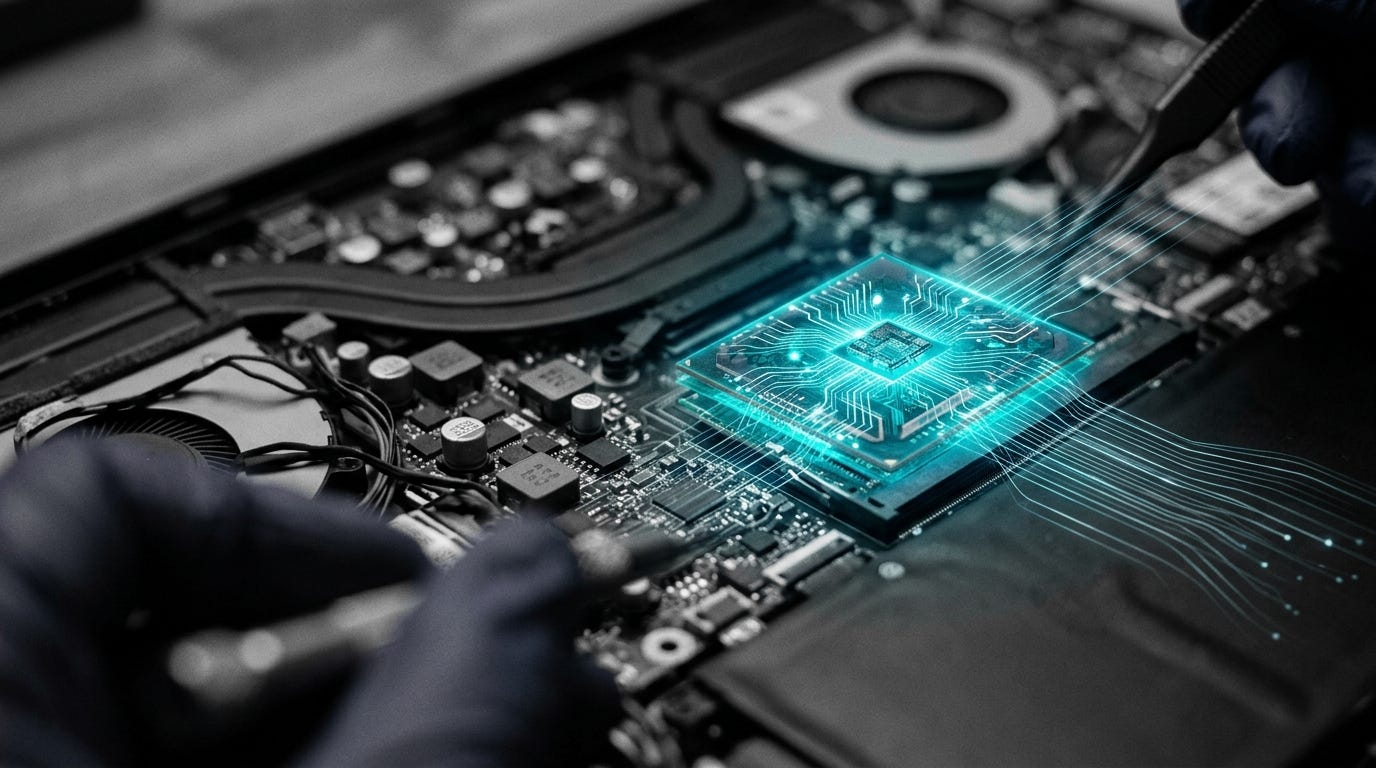
A weird thing keeps happening in AI right now: model headlines keep getting bigger, while the average laptop and GPU setup stays exactly the same. That gap usually ends with people giving up and renting inference from someone else. Air LLM attacks that resignation directly. Instead of asking for smaller models or expensive cards, it asks a sharper question: what if the bottleneck is not raw compute, but how weights get moved? That framing matters, because it turns “can’t run locally” into an engineering problem, not a law of nature.
The Drop: When VRAM Became the Entire Product
Open model culture has a distribution problem. The weights may be public, the benchmarks may look great, and the Hugging Face page may promise magic, but actually running a 70B model on normal hardware is where the fantasy usually dies. VRAM limits are brutal, especially once model sizes jump from “large” to “absurd.” A single failure mode dominates everything: out-of-memory errors before a useful token even appears.
Air LLM exists because the usual answers are unsatisfying. Quantize aggressively, lose some fidelity. Distill to a smaller model, lose capability. Rent cloud GPUs, lose privacy and cost control. That tradeoff has been hanging over local AI for a while, and honestly the interesting part is how many products quietly depend on users accepting it.
What makes this repo land is that it targets the exact friction point between open weights and actual access. Plenty of people do not need training infrastructure or research-grade clusters. They need a way to test, prototype, or ship with serious models on hardware that feels almost embarrassingly small. That is the gap Air LLM decided to own.
The Stack: Weight Streaming, Not Weight Worship
Under the hood, AutoModel gives Air LLM a single entry point that wraps Hugging Face model loading while handling architecture-specific differences behind the scenes. The stack is mostly Python, PyTorch, Transformers, Accelerate, and optional BitsAndBytes, with an MLX path for Apple Silicon and safetensors-based persistence for split model shards.
The Sauce: Loading Only What the Token Needs
Layer-wise streaming is the whole bet. Air LLM takes a model checkpoint, splits it into per-layer shards on disk, instantiates the model structure without allocating the full weights in memory, then loads each major module onto the GPU right before execution and frees it right after. That sounds simple, but it changes the economics of local inference.
A normal runtime treats the model like a resident object. Every layer has to live in VRAM because the forward pass might need it at any moment. Air LLM treats the model more like a timed sequence of assets. The runtime already knows the exact order in which transformer layers execute, so each layer can be pulled from storage just in time, attached for compute, then discarded. Prefetching overlaps loading the next layer with computation on the current one, which matters because disk transfer becomes the new constraint. Without that overlap, this would feel like a science project.
That design gets even more interesting with sparse MoE models. Per-expert streaming means only the experts actually selected for a token get loaded, instead of dragging an entire giant layer into memory. That is why the repo can make such wild claims around huge open models on tiny VRAM budgets. The trick is not that the hardware became stronger. The runtime got smarter about when weights need to exist.
The Move: Local AI Stops Being a Research Hobby
Founders and product teams can use Air LLM as a wedge into local-first AI without redesigning the whole stack. A straightforward move is running a larger open model for internal evaluation, red-teaming, or workflow prototyping on existing machines, instead of buying cloud inference before the use case is even proven. That alone can compress experimentation costs dramatically.
Another strong use case is controlled deployments in privacy-sensitive settings, e.g. legal review, enterprise search, or healthcare documentation, where sending prompts to a hosted API creates procurement headaches. Air LLM does not magically remove latency tradeoffs, but it changes the budget conversation. Bigger models become available for selective local tasks where accuracy matters more than blazing speed.
Teams building AI products should also read this repo as a strategy signal. If model runtimes keep getting better at squeezing giant weights through narrow hardware pipes, then “requires expensive GPU infrastructure” becomes a weaker moat. That shifts advantage toward product design, distribution, and workflow integration. In plain terms: better access to frontier-class open models lowers the tax on trying ambitious ideas.
The Aura: Expectations Get Reset Fast
People get used to constraints surprisingly quickly, then just as quickly forget them once a workaround appears. Air LLM pushes on that psychology. When a giant model can run on hardware that should not be enough, the mental model of what counts as “local” changes.
That matters beyond hobbyist bragging rights. Privacy starts feeling default instead of premium. Offline experimentation feels normal. Smaller teams stop assuming intelligence has to be rented from a hyperscaler. The deeper thesis here is that capability and ownership do not need to split apart forever. Once users taste that, expectations rarely go backward.
The Play: Inference Spend Gets Unbundled
This looks less like a pure 0-to-1 category and more like a sharp better mousetrap inside inference infrastructure, but the market is huge enough that the distinction barely matters. TAM spans local AI apps, enterprise on-prem deployments, edge inference, and the long tail of teams priced out of premium GPU stacks. With 25,396 stars, broad model support, and clear community pull around each new giant-model milestone, PMF signals look real, especially for developers and AI tinkerers hunting cost relief.
The moat is not data or network effects yet. It is execution speed, compatibility breadth, and a growing trust layer around “this weird model will probably run here too.” If that reliability compounds into a default runtime for open models on constrained hardware, switching costs become operational, not technical.
Winners:
Jan: Lower local inference costs make an open-model desktop assistant more capable, and that compounds through better user retention without cloud-margin pressure.
Mistral AI: Cheaper access to larger open weights expands distribution for premium-grade models, which strengthens ecosystem reach before every deployment turns into hosted API spend.
Apple: On-device AI narratives get more credible when serious models can run on consumer hardware, reinforcing the value of tightly integrated silicon and local compute.
Losers:
Together AI: Margin pressure rises when early experimentation no longer has to start in the cloud, and adapting is hard because usage-based revenue depends on being the default first stop.
CoreWeave: Some inference demand gets deferred or downsized when teams can prototype locally, which chips away at lower-end GPU consumption even if training demand stays strong.
NVIDIA: Entry-level hardware scarcity becomes a weaker upsell when software squeezes more usefulness from small VRAM footprints, especially for non-training workloads.
tl;dr
Air LLM turns giant open models into something normal hardware can actually run by streaming weights layer by layer instead of keeping the whole network in VRAM. That architecture is the point. Anyone tracking local AI, on-device products, or cloud inference cost pressure should look closely.
Stars: 25,396 | Language: Jupyter Notebook
