


GitNexus: Code Search Was Too Shallow
github.com/abhigyanpatwari/GitNexus | License: Other

A repo stops making sense right when the stakes go up. The AI assistant can summarize files, maybe even explain a function, then completely miss the dependency that breaks checkout, the call chain that triggers billing, or the service boundary hiding in a monorepo. That gap is exactly where trust collapses. GitNexus goes after the architectural blind spot, not the autocomplete problem. And the pitch is sharp: build a full code knowledge graph locally, expose it to an AI agent, and stop letting code intelligence stay trapped at the file-search layer.
The Drop: When Repo Chat Stops Being Useful
Plenty of tools can talk about code. Fewer can reason across it. That difference sounds subtle until an agent edits one module and misses the import chain, touches an endpoint without seeing the downstream service, or confidently “understands” a repository by stitching together embeddings and vibes. In larger codebases, that failure mode is constant.
GitNexus exists because repo understanding has been weirdly shallow. Search gets snippets. Embeddings get semantic similarity. LLMs get prose summaries. None of those naturally produce a structural map of what actually depends on what. That matters more than the summary, honestly, because software breaks through relationships, not descriptions.
Another pressure point sits underneath the hype cycle: privacy and speed. Teams want rich code intelligence, but uploading internal repositories to a server just to ask better questions is a nonstarter in a lot of companies. GitNexus answers that with a browser and local-first setup that turns a GitHub repo or ZIP into something navigable, queryable, and agent-readable, without shipping the code off-box. That is the frustration it targets, shallow understanding plus uncomfortable infrastructure tradeoffs.
The Stack: Browser-Native, Agent-Ready
Under the hood, GitNexus is mostly TypeScript, with a React and Vite web app, Tree-sitter for parsing, and LadybugDB as the graph storage layer, including a WASM version in the browser. The project also exposes an MCP server, which is the bridge that lets tools like Claude Code or Codex query the indexed repository as structured context instead of raw text.
The Sauce: A Nervous System, Not a Search Box
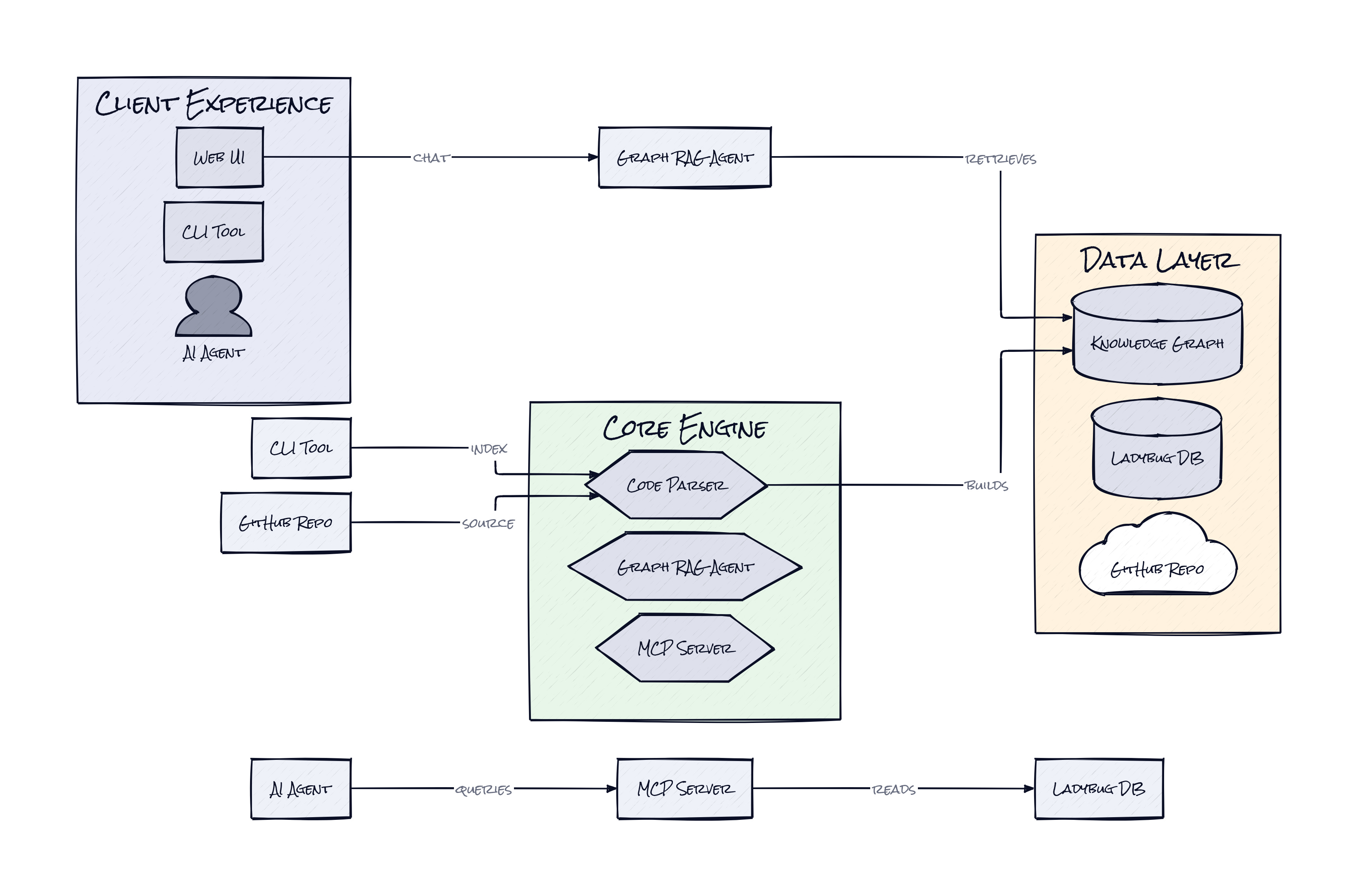
What makes GitNexus interesting is the decision to treat code intelligence as a persistent graph problem, not a chat problem. The repo parses code into entities and relationships, then stores those links in a graph database so questions can traverse architecture instead of retrieving disconnected chunks. In practice, that means the system can reason about imports, call chains, clusters, execution paths, and cross-repo service boundaries as first-class structure.
Several pieces stack together here. Graph RAG is the obvious headline, but the more important layer is the index itself. GitNexus builds a structural representation before the model gets involved, so the LLM is consuming shaped context rather than trying to infer architecture from text scraps. That changes reliability. A normal retrieval system finds relevant files. A graph-backed one can answer, “what else does this change touch?” which is a much more operational question.
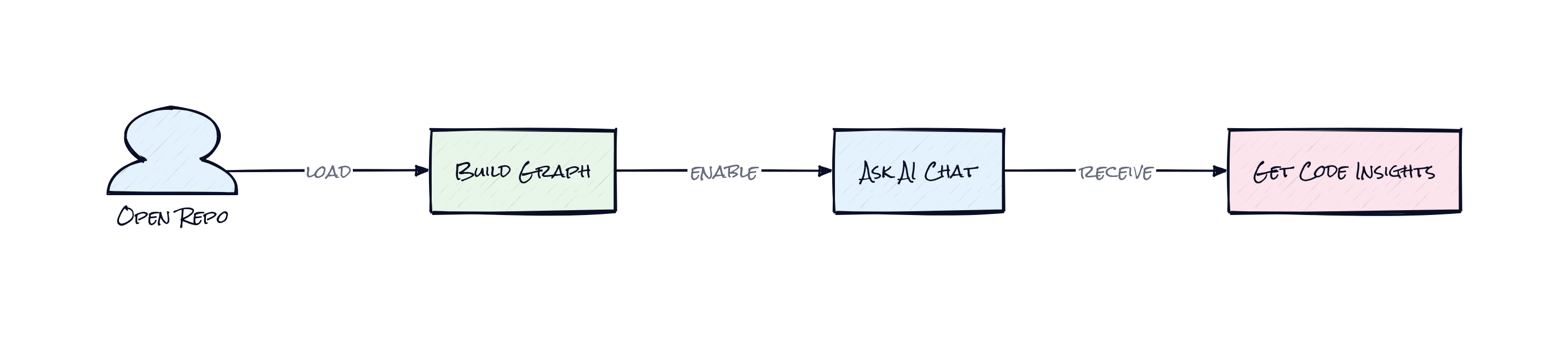
The second smart move is the split between Web UI, CLI + MCP, and Bridge Mode. The browser version lowers the barrier to entry, drop in a repo, explore visually, ask questions. The CLI path is where the serious value shows up, because the graph becomes ambient context for coding agents inside existing tools. Bridge Mode then connects local indexing to the web explorer without re-uploading or re-indexing, which is a very practical design choice. It preserves privacy, avoids duplicate work, and makes the graph reusable across workflows.
Honestly, the interesting part is not that GitNexus chats with a repo. Plenty of products do that. The interesting part is that GitNexus creates an architectural memory layer that can sit underneath multiple interfaces, human exploration, automated review, agent planning, and code wiki generation.
The Move: Turn Repo Context Into an Advantage
Instead of treating GitNexus like a prettier graph viewer, the better move is to use it where mistakes are expensive. Start with a codebase that already has hidden complexity, e.g. a monorepo, a service-heavy backend, or an inherited internal tool nobody fully owns. Index it locally, connect the MCP server to the coding assistant already in use, and make every code suggestion operate against structural context.
That changes a few workflows immediately. Product and engineering leads can inspect blast radius before approving a risky feature. Founders using AI to move fast on old code can ask where a billing flow fans out before touching anything. New hires can navigate actual system topology instead of reading stale docs. Teams can also generate an always-fresh wiki from the graph, which matters because static documentation usually dies the minute incentives disappear.
Strategically, GitNexus seems strongest as trust infrastructure for AI coding. Better code generation is nice. Fewer blind edits, fewer broken dependencies, and faster architectural onboarding are compounding. The payoff is not one good answer, it is fewer bad ones making it into production.
The Aura: Software Finally Explains Its Shape
People change how they work when the system stops feeling opaque. A tangled repo usually trains caution, cargo-cult edits, and dependence on the one engineer who “just knows” where everything connects. GitNexus chips away at that social bottleneck by making structural knowledge visible and queryable.
That matters beyond code. Shared maps change power dynamics. When architecture becomes easier to inspect, onboarding gets less political, AI tools become less reckless, and teams can move with more confidence through systems that used to feel like institutional memory traps. The broader thesis is simple: software is easier to change when its relationships are legible.
The Play: Infra for Trust, Not Just Convenience
From a VC lens, GitNexus looks less like a 0-to-1 new category and more like a strong wedge into the code intelligence and AI developer tooling TAM, which is already huge and still underbuilt. The PMF signal is obvious, nearly 30,000 stars, active community energy, enterprise packaging, and a product shape that spans hobbyist browser use up to self-hosted commercial deployment. The moat is not raw model access. It is execution around structural indexing, workflow integration, and the sticky behavior change of making graph context a default layer for code work. If that behavior locks into review, onboarding, and AI-assisted edits, LTV gets interesting fast and CAC can stay low through open source pull.
Winners:
Mintlify: Better auto-generated docs get harder to commoditize when structural code graphs feed always-current architectural explanations that compound with every indexed repo.
Cognition: Higher-confidence agent coding improves when architecture-aware context reduces failed edits and rework across complex repositories.
Oracle: Deeper code graph infrastructure strengthens enterprise modernization and governance pitches, especially in large legacy estates where understanding dependencies is half the spend.
Losers:
Sweep: Thin repo-level automation erodes when buyers start expecting architectural blast-radius awareness instead of file-by-file patching.
Sonar: Static analysis looks narrower when teams want interactive, agent-consumable structure rather than mostly report-driven insight.
Box: Generic enterprise knowledge layers lose ground for technical teams if the highest-value internal context becomes live code topology, not stored documents.
tl;dr
GitNexus turns a codebase into a local knowledge graph that AI agents and humans can actually reason over. The smart part is the graph-first architecture, plus MCP connections that pipe structural context into coding tools. Worth a look for anyone dealing with messy repos, AI coding reliability, or fragile onboarding.
Stars: 29,893 | Language: TypeScript
